

More of your customers now ask ChatGPT questions such as "who is the best removals company in Leeds?" or "which accounting software suits a small business?" before they search Google. ChatGPT replies with a short answer and a few named businesses. If yours is one of them, you win a customer who already trusts you. This guide explains how ChatGPT builds its answers, how SEO and AEO (answer engine optimisation) get your business named, and the exact steps to rank in ChatGPT in 2027, whether you sell to other businesses, to consumers or to people nearby.
What is ChatGPT, and who owns it?
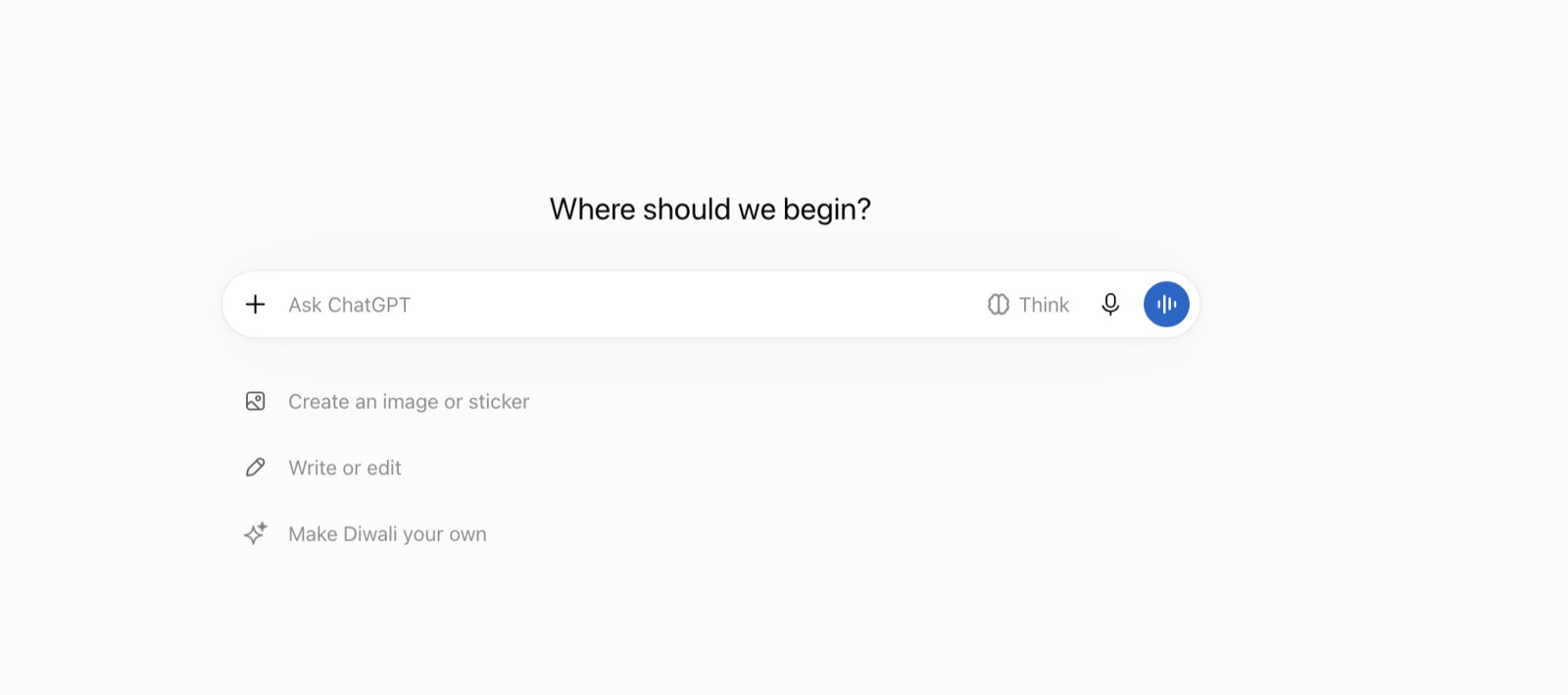
ChatGPT is an AI assistant made by OpenAI, an American AI company. GPT stands for "Generative Pre-trained Transformer", the type of AI model that powers it. People use ChatGPT to answer questions, write and edit text, create images, research products and services, analyse files and plan tasks. For your business, the use that matters most is research: people asking ChatGPT what to buy and who to buy it from.
Where does ChatGPT get its information from?
ChatGPT answers from two sources. Its training data is a large snapshot of public web pages, books and other text collected before the model was released. Its web search reads live pages when a question needs current or specific information, such as prices, reviews or local suppliers, and it shows links to the sources it used. For questions about which business to choose, web search does most of the work.
How does ChatGPT build an answer? RAG and query fan-out explained
When ChatGPT searches the web, it uses a method called retrieval-augmented generation (RAG). It retrieves pages first, then writes its answer from what those pages say. Understanding these steps shows you exactly where your business can win or lose a place in the answer.
Step 1: ChatGPT decides whether to search
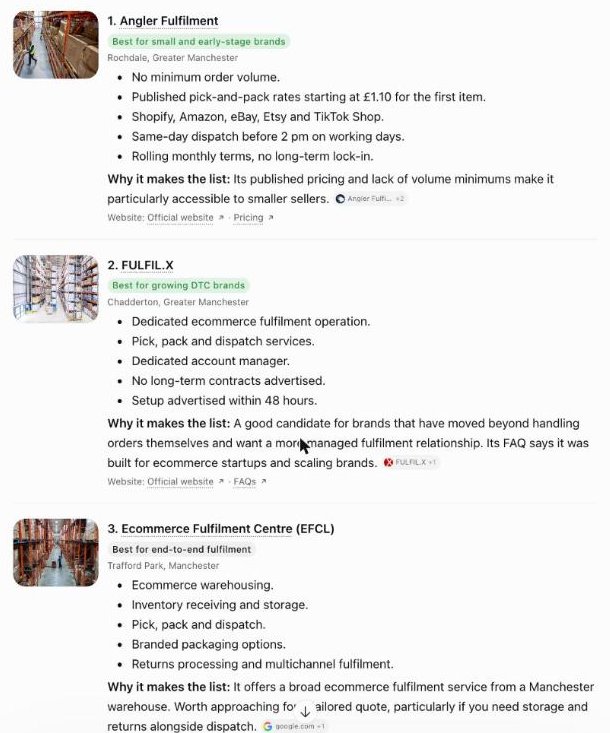
For general knowledge, such as "what is a 3PL?", ChatGPT may answer from training data alone. For anything current, local, priced or comparative, such as "best 3PL for a small ecommerce brand in the UK", it runs a web search. Most buying questions trigger a search.
Step 2: Query fan-out turns one question into several searches
ChatGPT rarely searches the exact words your customer typed. It rewrites the question into several shorter searches, a process called query fan-out. A question like "best 3PL for a small ecommerce brand in the UK" might become searches such as "3PL for small ecommerce UK", "3PL pricing per pallet UK", "3PL reviews UK" and "best fulfilment companies UK 2027".
This matters because your business can be found through any of those smaller searches. A page that ranks for "3PL pricing per pallet UK" can earn you a place in the answer even if you never rank for the original question.
Step 3: Retrieval pulls in pages from search providers
ChatGPT sends those searches to third-party search providers, of which Microsoft's Bing is the best known, and its own crawler, OAI-SearchBot, fetches pages. It collects the top results from each search, so the same business appearing across several of them gets a stronger signal.
Step 4: ChatGPT reads, compares and writes the answer
ChatGPT breaks the pages into passages and picks the ones that answer the question most clearly. It then writes a summary, names the businesses that appear most often and most credibly, and links to its sources. A business mentioned by your own website, a trade publication and a review site at once looks far more trustworthy than one mentioned only by itself.
How is ChatGPT different from Claude, Gemini, Grok and Copilot?
Each AI assistant reads the web through a different search source, so your business can appear in one and not another. ChatGPT draws on third-party search providers including Bing. Gemini and Google's AI Overviews draw on Google Search. Microsoft Copilot draws on Bing. Claude, made by Anthropic, runs web searches through its own search provider and cites pages inline. Grok, made by xAI, draws heavily on posts from X as well as the web.
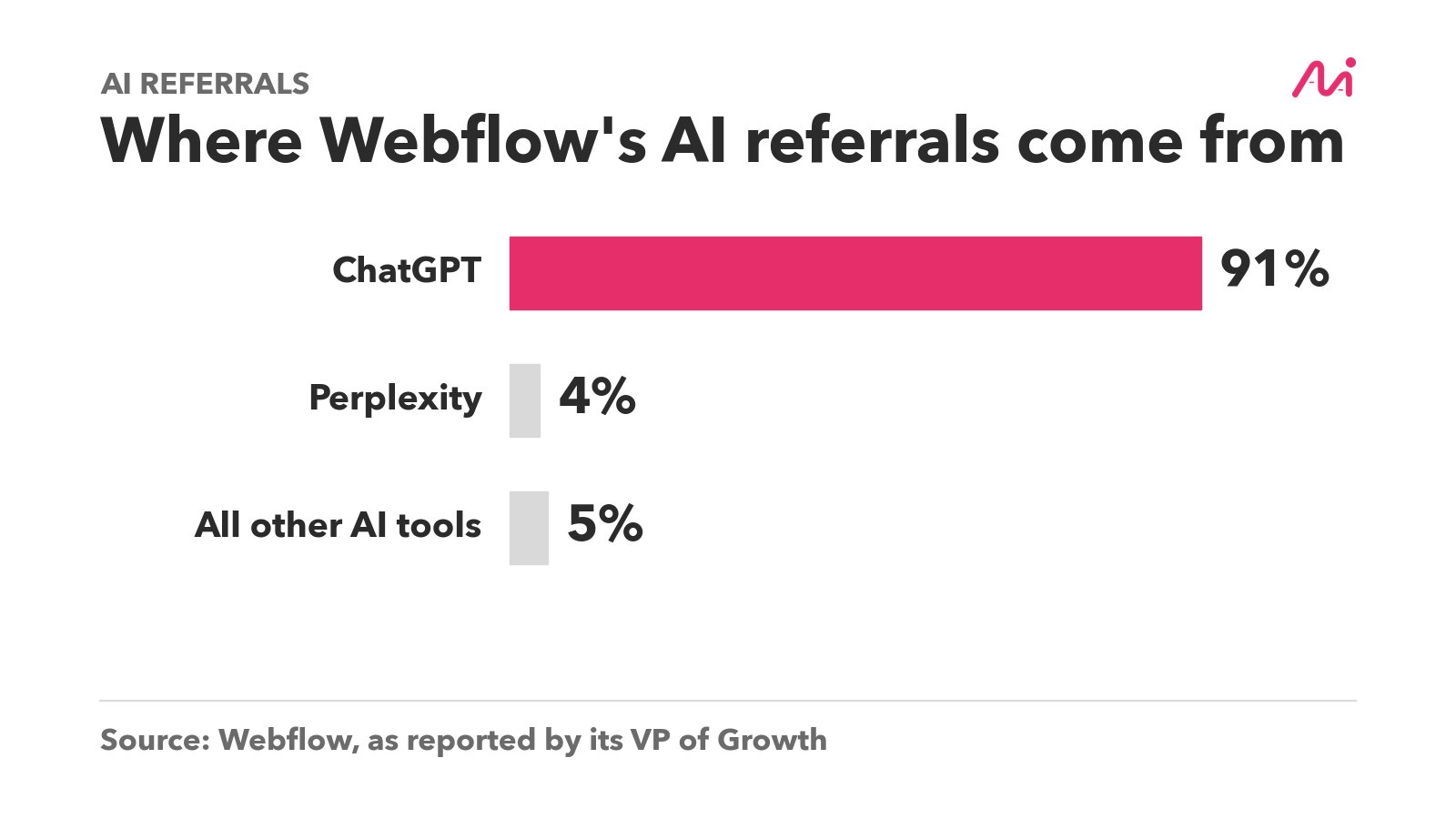
ChatGPT is also where most AI referral traffic comes from today. Webflow's VP of Growth reported that 91% of the company's AI referrals came from ChatGPT, with Perplexity at 4% and all other AI tools sharing the rest.
People often ask whether Grok or Copilot is better than ChatGPT. Each suits different tasks, and the answer depends on what you use it for. For your business, the more useful question is which assistants your customers use, so you can appear in each. Our guides on how to rank in Claude and how to rank in AI Overviews and AI Mode cover the others.
Does SEO help you rank in ChatGPT?
Yes. ChatGPT finds most of its sources through search engines, so a website that ranks well is far more likely to be read, quoted and recommended. Because of query fan-out, ranking for many related questions matters as much as ranking for your main keyword.
Competitors with more mentions on forums and blogs get recommended more.
That marketer also argues that SEO alone doesn't move the needle, and there is truth in it. Rankings get your pages read; mentions on other sites decide whether ChatGPT trusts you enough to name you. A properly SEO-optimised website is where it starts, with a few additions for AI. That website needs:
- pages indexed in both Bing and Google
- a clear page for each service and location you cover
- fast, crawlable pages with the main content in plain HTML
- content that answers the many smaller questions behind each buying decision
AEO builds on that foundation. It shapes your content and reputation so ChatGPT chooses your business when it writes its answer. Our guide to answer engine optimisation explains how the two fit together.
How to rank your business in ChatGPT, step by step
1. Check what ChatGPT says about you today
Start by finding out where you stand. Ask ChatGPT the questions your customers ask, and note which businesses it names, which sources it links to and what it says about you.
- Write 10 to 20 prompts your customers would use, such as "best [service] in [city]" or "[service] for small businesses in the UK".
- Run each prompt in ChatGPT with search on, using a fresh session.
- Ask "what do you know about [your business name]?" and check the facts are correct.
- Open the sources panel and list every site ChatGPT cites. These are the sites you want to rank on or be mentioned by.
- Repeat monthly with the same prompts.
2. Get indexed in Bing and submit to Bing Webmaster Tools
Since Bing is one of the main search sources behind ChatGPT, a site missing from Bing can be missing from ChatGPT too. Many businesses only ever check Google, so this step is often the quickest win.
- Create a free Bing Webmaster Tools account and verify your site (you can import it from Google Search Console).
- Submit your XML sitemap.
- Use URL Inspection to check your key pages are indexed.
- Set up IndexNow so Bing hears about new and updated pages straight away.
- Check robots.txt allows OAI-SearchBot and Bingbot.
3. Write answer-first pages for every question behind the buying decision
ChatGPT lifts short, clear passages, so each page should answer its question in the first two or three sentences. Query fan-out means you also need pages for the smaller questions buyers ask on the way to a decision: cost, comparisons, timelines and suitability.
- Create one page per service, and one per location if you serve several areas.
- List the fan-out questions for each service: price, process, timeline, alternatives, reviews and who it suits.
- Write headings as those questions, such as "How much does office removal cost in London?".
- Answer each one in 40 to 60 words under the heading, then add detail.
- Add an FAQ section and FAQ schema to your main service pages.
4. Build authority with digital PR
ChatGPT trusts businesses that other credible sources talk about. Digital PR earns that coverage: stories, data and expert comments that journalists and trade publications want to use. Each article that names you becomes another source ChatGPT can retrieve, and coverage on respected sites signals that your business is worth recommending.
- Publish original data from your own work, such as average costs, timelines or customer survey results, and pitch it to journalists.
- Offer expert comment through journalist request services and on topical industry news.
- Write guest articles for trade publications your buyers read.
- Appear on industry podcasts, webinars and event speaker lists.
- Enter industry awards and apply for "best of" and "top companies" lists in your category.
- Track every new mention, and check whether ChatGPT starts citing those articles.
5. Build mentions on directories and review sites
Directories and review sites confirm the basics: that you exist, what you do and whether customers rate you. ChatGPT often cites them directly in its answers.
- List your business on the main directories for your industry and country.
- Collect reviews on Google, Trustpilot or the review sites your customers use, and reply to them.
- Answer questions in Reddit, LinkedIn and industry forums where people ask for recommendations, as yourself and without hard selling.
6. Keep your business details consistent everywhere
If your name, address, services or phone number differ between sites, ChatGPT may be unsure which details are correct, or mix you up with another business.
- Use the exact same business name and description on every listing.
- Keep your address and phone number identical across your website, Google Business Profile, Bing Places and directories.
- Add Organization schema to your website with links to your official profiles.
- Update every listing when anything changes.
How to rank a B2B business in ChatGPT
B2B buying is slower, higher in value and made by a group. A buying team may include an operations manager, a finance lead and a director, and each asks ChatGPT different questions over weeks or months. To rank a B2B business in ChatGPT, your content and reputation need to answer every one of those people.
What do B2B buyers ask ChatGPT?
Take a UK online retailer looking for a new fulfilment partner. Over a few weeks, the buying team might ask:
- Operations: "Which 3PLs in the Midlands can handle same-day dispatch for 2,000 orders a day?"
- Finance: "How much does 3PL fulfilment cost per order in the UK?"
- Director: "What are the risks of switching 3PL during peak season?"
- All of them: "Compare [Company A] and [Company B] for ecommerce fulfilment."
ChatGPT fans each question out into several searches. The 3PL that appears across the answers, on its own site, in trade press and in reviews, becomes the favourite before anyone books a call.
The intent from those leads felt noticeably higher.
What content does a B2B business need to rank in ChatGPT?
- Service and industry pages: one page per service, and one per industry you serve, such as "3PL for health and beauty brands". Specific pages match specific questions.
- Pricing guidance: price ranges and what drives cost. B2B firms often avoid this, which leaves ChatGPT to quote someone else.
- Comparison pages: fair comparisons of approaches or options, such as "in-house warehousing vs 3PL".
- Case studies: the problem, what you did and the measured result, described by industry and market.
- Proof of capability: certifications, accreditations, locations, capacity and systems you integrate with, written as plain facts ChatGPT can repeat.
- Risk and process content: onboarding steps, timelines and how you handle problems, which answer the director's questions.
Where should a B2B business be mentioned?
- Trade publications and industry news sites your buyers read.
- Industry association member directories.
- B2B review platforms such as Clutch or G2, where relevant to your sector.
- LinkedIn, through company and founder posts that share real expertise.
- Partner and supplier pages, such as software you integrate with.
B2B steps to rank in ChatGPT
- Map the questions each member of the buying team asks, from first research to final decision.
- Build or improve a page for each of those questions.
- Publish at least one case study per core service and industry.
- Add pricing guidance, even as ranges.
- Earn coverage in two or three trade publications through data or expert comment.
- Test the buying team's prompts in ChatGPT monthly and track who is named.
How to rank a B2C business in ChatGPT
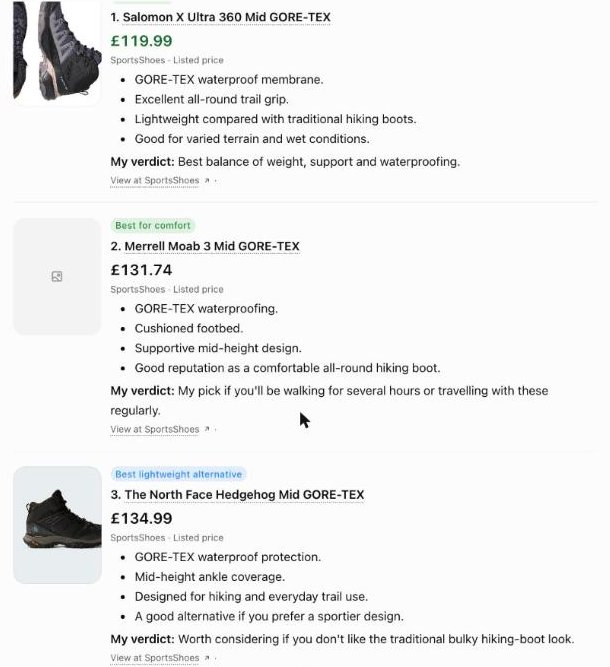
Consumers ask quicker questions and often decide in a single session. ChatGPT builds these answers mostly from reviews, product details, buying guides and "best of" lists, and it can show products with images, prices and links in its shopping results.
What do B2C customers ask ChatGPT?
Take someone buying a new mattress. They might ask "best mattress for back pain under £600", then "is [Brand A] or [Brand B] better for side sleepers?", then "does [Brand A] offer a free trial?". ChatGPT fans these out into searches for reviews, prices, return policies and buying guides, then names the brands that appear across them.
What does a B2C business need to rank in ChatGPT?
- Complete product and service pages: price, specifications, sizes, who it suits and what makes it different, written as clear facts.
- Accurate product data: Product schema with price, availability and reviews, and consistent prices across your site and retailers.
- Policy information: delivery, returns, warranties and trials on clear pages, since shoppers often ask about these.
- Reviews: a steady flow of recent reviews on Google, Trustpilot and retailer sites.
- Buying guide coverage: inclusion in "best of" articles from publishers, consumer review sites and niche bloggers.
- Community presence: genuine discussion on Reddit and forums, where ChatGPT often looks for honest opinions.
How do you check if your website appears in ChatGPT product recommendations?
Ask ChatGPT for products in your category, such as "best waterproof walking boots under £150", with search on. Look for your products in the results and check which sites are cited. Repeat with different budgets, uses and locations, and note where competitors appear and you do not. The cited buying guides become your PR target list.
B2C steps to rank in ChatGPT
- Fill every product page with price, specifications, use cases and FAQs.
- Add Product and Review schema, and keep prices consistent everywhere.
- Ask every customer for a review after purchase.
- Pitch your products to the buying guides ChatGPT already cites.
- Send samples to reviewers and creators in your category.
- Test your top product prompts monthly.
How to rank a local business in ChatGPT for "near me" searches
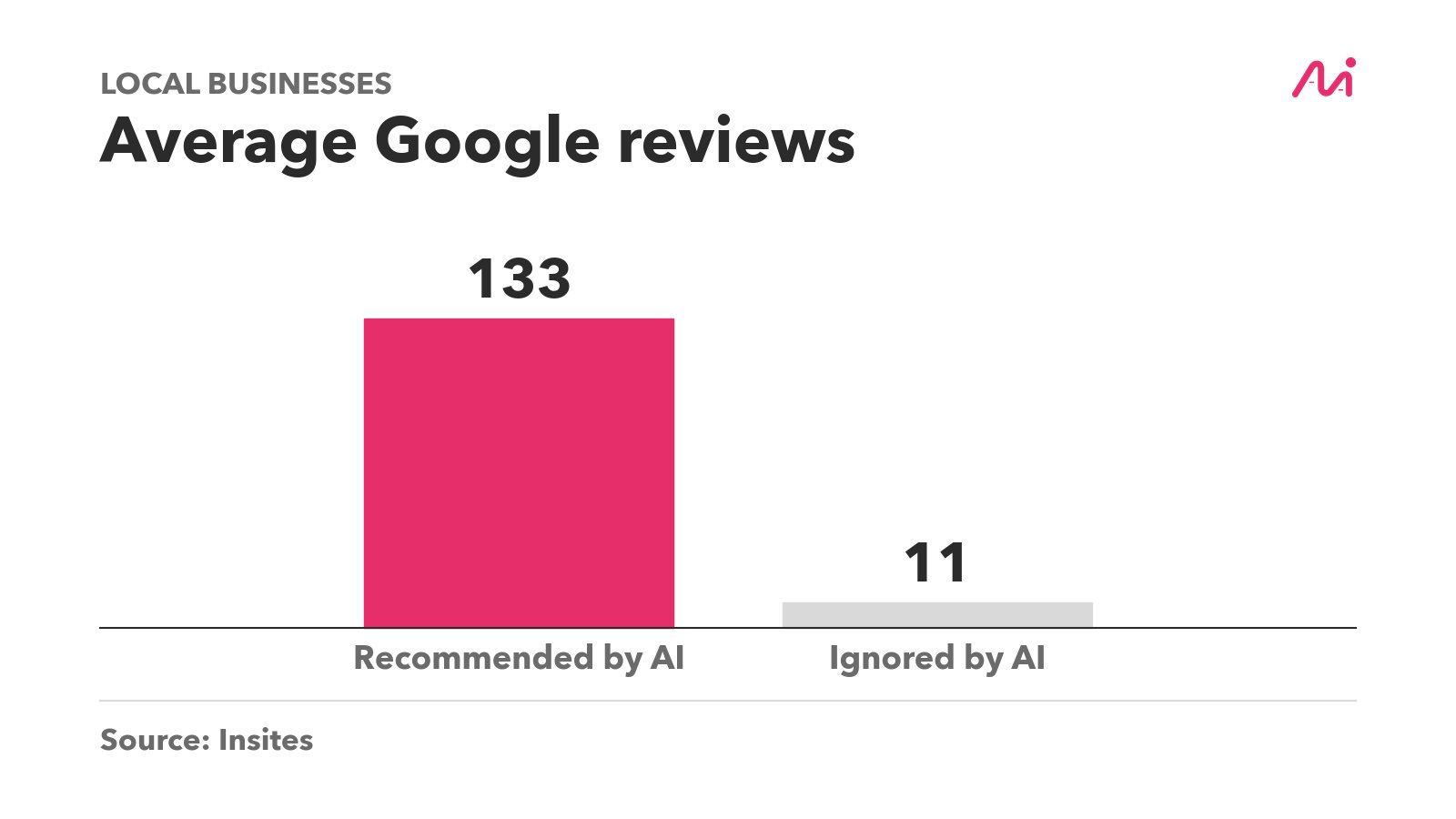
When someone asks ChatGPT for a business "near me", it uses their approximate location and relies heavily on map listings, local directories and reviews. Reviews make a striking difference: research by Insites found that local businesses recommended by ChatGPT and Perplexity averaged 133 Google reviews, compared with 11 for businesses the AI tools ignored. For a worked example, see our guide to Google My Business for self storage.
- Claim and complete your Bing Places for Business listing, as well as your Google Business Profile.
- Choose accurate categories and list every area you serve.
- Build a page on your website for each town or area you cover.
- Collect reviews that mention your service and location, and reply to every one.
- Get listed in local directories and covered by local news sites.
How to see if ChatGPT sends traffic to your website
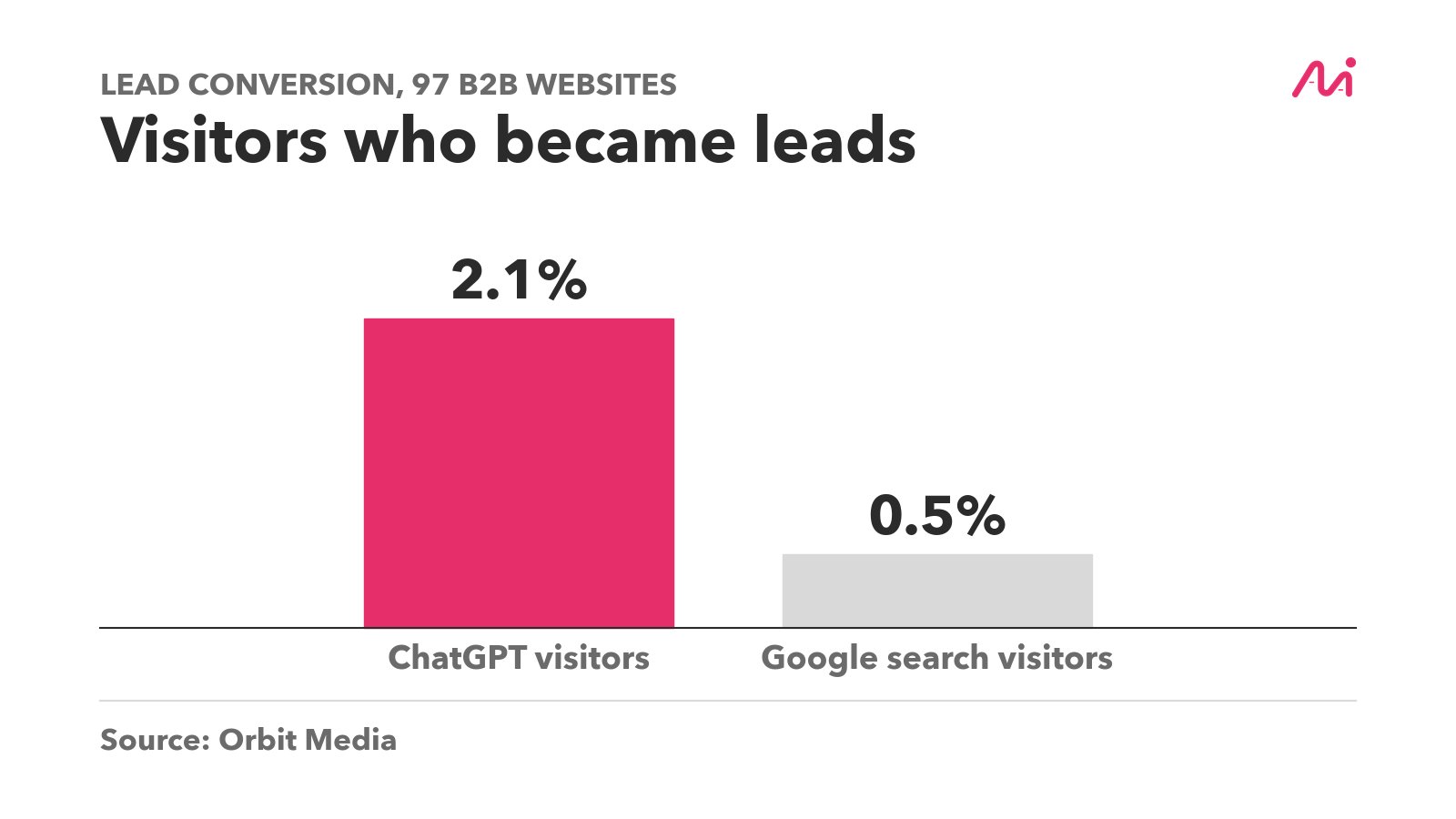
ChatGPT adds a tracking tag (utm_source=chatgpt.com) to many of the links it shows, so its visits appear in your analytics. Those visits are worth tracking closely, because they convert well. Orbit Media analysed 97 B2B websites and found ChatGPT visitors converted to leads at 2.1%, compared with 0.5% for Google search.
- In Google Analytics 4, open Reports, then Acquisition, then Traffic acquisition.
- Set the dimension to "Session source / medium" and search for "chatgpt".
- Check which landing pages those visits arrive on, and whether they turn into enquiries.
- Add "ChatGPT or another AI tool" as an option on your "how did you hear about us?" form.
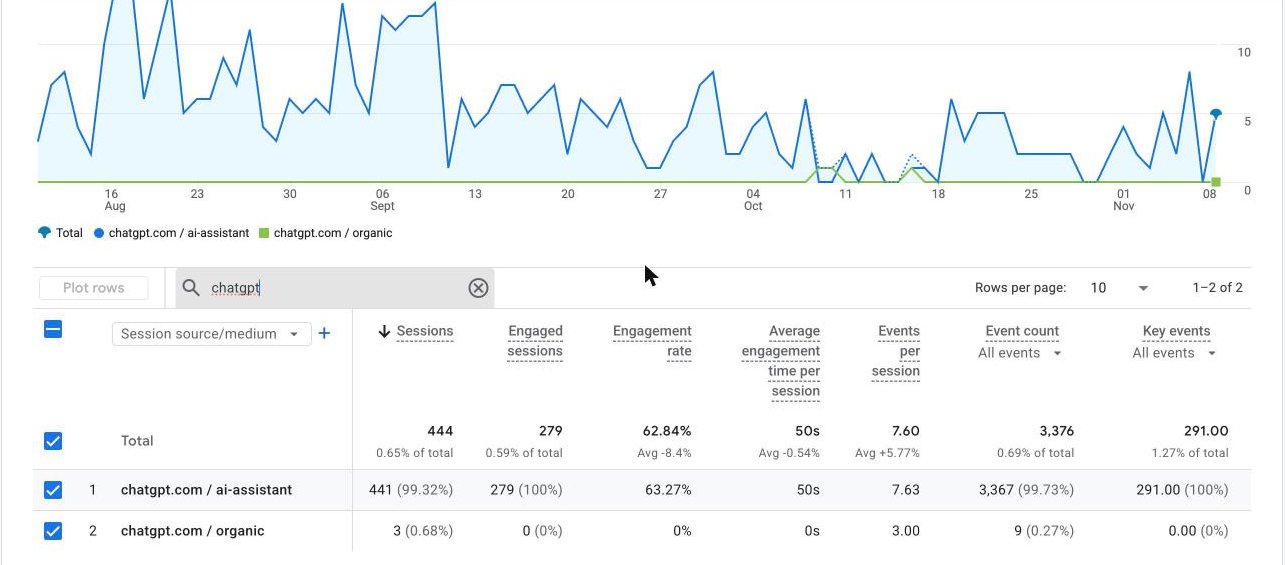
In my data chatgpt traffic converted 1.5 to 2x higher than organic.
The same marketer notes that volume is still small, so the total revenue lift depends on your deal size. That is why tracking enquiries matters as much as tracking visits. Our guide on how to track AI traffic for free covers every setting in GA4 and Search Console.
FAQ
Is ChatGPT safe to use for my business?
ChatGPT is safe for everyday tasks such as drafting, research and brainstorming. Treat it like any online service: avoid entering passwords, customer data or anything you would not share outside the business, unless you use a business plan with data controls in place.
Is ChatGPT safe for confidential information?
On free and personal plans, your chats may be used to improve OpenAI's models unless you turn this off in settings. OpenAI's business plans exclude your data from training by default. Check OpenAI's current privacy policy and your own data rules before sharing anything confidential.
Does ChatGPT share your data?
OpenAI states that it does not sell your data. Chats can be used to improve its models on personal plans unless you opt out, and you can delete chats or turn off chat history in settings.
Is ChatGPT GDPR compliant?
OpenAI offers a data processing agreement for business customers and publishes privacy terms for users in the UK and EU. Whether your use is GDPR compliant depends on what data you enter and how, so check with your data protection lead before using ChatGPT with personal data.
How much is ChatGPT in the UK?
ChatGPT has a free plan and several paid plans for individuals and teams, priced monthly.
Which ChatGPT model is best?
The default model suits most everyday questions. Reasoning models handle complex analysis, maths and planning better but take longer to answer. For ranking your business, the model matters less than whether ChatGPT search can find you.
Can ChatGPT generate images?
Yes. ChatGPT can create and edit images from a written description, such as a product mock-up, a social media graphic or an illustration for a blog post. An image usually takes from a few seconds to a minute or two, depending on its detail and how busy the service is. Free users can create a limited number of images, and paid plans such as ChatGPT Plus allow more.
Can ChatGPT create videos?
OpenAI's video model, Sora, creates short videos from text and images, and it is available to some ChatGPT users depending on their plan and country. The standard ChatGPT chat focuses on text and images.
Can ChatGPT analyse videos?
ChatGPT can analyse images, screenshots, PDFs and documents you upload. Support for analysing full video files is limited, so a reliable approach is to upload a transcript or screenshots of key moments and ask ChatGPT to analyse those.
Do I need to pay for ChatGPT to appear in its answers?
No. Your business appears in ChatGPT's standard answers because of your website, rankings, reviews and mentions across the web.
How long does it take to rank in ChatGPT?
Once Bing indexes a new or improved page, ChatGPT search can start citing it within a few weeks. Being recommended consistently usually takes three to six months, as reviews, PR coverage and rankings build up. Want to know what ChatGPT says about your business today? Book a call with Team MAAI.