

Claude is fast becoming the AI assistant professionals use for serious research: comparing suppliers, checking a market, or building a shortlist before a big purchase. When someone asks Claude "which commercial cleaning companies in Birmingham work with offices over 10,000 sq ft?", it searches the web, reads the best sources and names a few businesses. This guide explains how Claude finds and chooses those businesses, how SEO and AEO (answer engine optimisation) get yours named, and the exact steps to rank in Claude in 2027 for B2B, B2C and local businesses.
What is Claude, and who makes it?
Claude is an AI assistant made by Anthropic, an AI safety and research company based in San Francisco. People use Claude to research, write, analyse documents and data, code and plan work. It is especially popular for work tasks, which means many of the people asking Claude for recommendations are professionals making decisions for a business.
Where does Claude get its information from?
Claude answers from two sources. Its training data is a large snapshot of public web pages and other text collected before each model was released. Its web search reads live pages when a question needs current or specific information, and Claude cites the sources it used inline, next to the sentence they support. For questions about suppliers, prices and reviews, web search does most of the work.
How does Claude build an answer? RAG and query fan-out explained
When Claude searches the web, it uses retrieval-augmented generation (RAG). It retrieves pages first, then writes its answer from what those pages say. Here is how that works, step by step.
Step 1: Claude decides whether it needs to search
For general knowledge, Claude can answer from training data. For anything current, local, priced or comparative, it searches. Claude can also run several rounds of searching on one question, reading results and then searching again to fill gaps, which makes it thorough on complex buying questions.
Step 2: Query fan-out turns one question into several searches
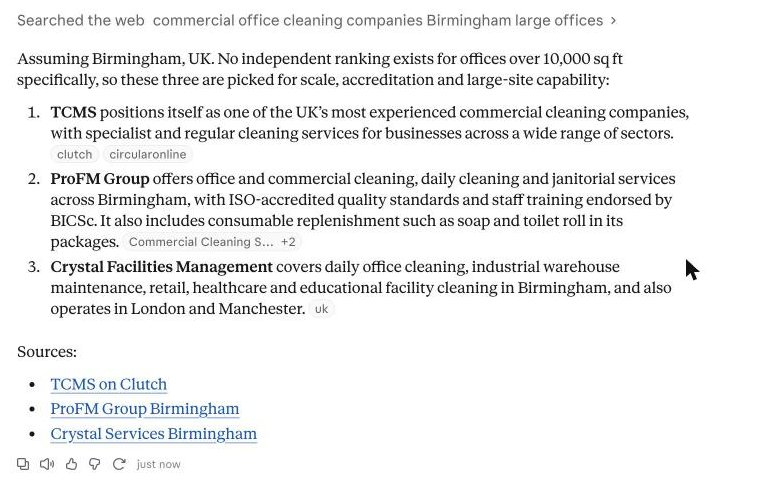
Claude rewrites your customer's question into a set of focused searches. "Which commercial cleaning companies in Birmingham work with large offices?" might become "commercial office cleaning Birmingham", "office cleaning contract prices Birmingham" and "commercial cleaning company reviews Birmingham". Each search is a separate chance for your business to be found.
Step 3: Retrieval pulls in pages from a search index
Claude sends those searches to its web search provider and fetches the top pages with its own crawlers. Anthropic runs separate crawlers for training (ClaudeBot), for search (Claude-SearchBot) and for pages users ask Claude to open (Claude-User). If your site blocks the search crawler, Claude may be unable to read or cite your pages.
Step 4: Claude reads, cross-checks and writes the answer
Claude reads the retrieved pages, compares what they say and writes an answer with inline citations. It tends to favour sources that are specific, well-structured and consistent with other sources. A business described the same way on its own site, in a trade publication and on a review site is far easier for Claude to recommend with confidence.
How is Claude different from ChatGPT, Gemini and Perplexity?
Each assistant uses a different search source, so your business can appear in one and be missing from another. ChatGPT draws on third-party providers including Bing. Gemini and Google's AI Overviews draw on Google Search. Perplexity runs its own search for almost every question. Claude uses its own web search provider and its own crawlers.
Two differences matter most for your business. Claude cites sources inline, sentence by sentence, so the pages it quotes are easy for the reader to click. And Claude's audience leans towards professionals and knowledge workers, which makes it especially valuable for B2B businesses. Our guide on how to rank in ChatGPT covers that platform in detail.
Does SEO help you rank in Claude?
Yes. Claude finds its sources through a search index, so a website that ranks well, loads cleanly and answers questions clearly is far more likely to be retrieved and cited. Because of query fan-out, ranking for many of the smaller questions around your service matters as much as ranking for your main keyword.
Getting mentioned on ChatGPT, Gemini etc is basically just SEO.
That matches what we see across client work. A properly SEO-optimised website needs:
- pages indexed in the major search engines
- a clear page for each service and location you cover
- fast pages with the main content in plain HTML, since AI crawlers often do not run JavaScript
- content that answers the questions behind each buying decision
AEO builds on that foundation so Claude chooses your business when it writes its answer. Our guide to answer engine optimisation explains how the two fit together.
How to rank your business in Claude, step by step
1. Check what Claude says about you today
Start by finding out where you stand. Ask Claude the questions your customers ask, with web search on, and note which businesses it names and which sources it cites.
- Write 10 to 20 prompts your customers would use, such as "best [service] in [city]" or "[service] for mid-sized businesses in the UK".
- Run each prompt in Claude with web search turned on.
- Ask "what do you know about [your business name]?" and check every fact.
- List every source Claude cites. These are the sites you want to rank on or be mentioned by.
- Repeat monthly with the same prompts.
2. Let Claude's crawlers reach your site
Some websites block AI crawlers by default, often through a security setting or a robots.txt rule added years ago. If Claude-SearchBot cannot reach your pages, Claude cannot cite them.
- Open yoursite.com/robots.txt and check it does not block Claude-SearchBot, Claude-User or ClaudeBot.
- Check your firewall or CDN (for example Cloudflare) is not blocking AI crawlers.
- Make sure your main content appears in the page HTML, not only after JavaScript runs.
- Submit your sitemap to Google Search Console and Bing Webmaster Tools so your pages are indexed widely.
3. Write clear, well-structured, answer-first pages
Claude quotes passages that answer a question directly and back it up with specifics. Pages with clear headings, short answers and supporting facts are much easier for Claude to cite sentence by sentence.
- Create one page per service, and one per location or industry you serve.
- Write headings as the questions customers ask.
- Answer each question in 40 to 60 words under the heading, then add detail.
- Back claims with numbers, sources, standards and dates.
- Show who wrote or reviewed the page, and when it was last updated.
4. Build authority with digital PR
Claude cross-checks sources before it recommends a business, so being covered by credible third parties carries real weight. Digital PR earns that coverage, and each article that names you becomes another page Claude can retrieve and cite.
- Publish original data from your work, such as costs, timelines or survey results, and pitch it to journalists.
- Offer expert comment on industry news through journalist request services.
- Write guest articles and opinion pieces for trade publications.
- Speak at events, webinars and podcasts, and make sure the event pages name your business.
- Apply for industry awards and "top companies" lists.
5. Build mentions on directories, review sites and communities
Directories and review sites confirm the basics: that you exist, what you do and what customers think. Claude often cites them when it compares options.
- List your business on the main directories for your industry and country.
- Collect reviews on Google, Trustpilot or the platforms your customers use.
- Take part in Reddit, LinkedIn and industry forums where people ask for recommendations.
6. Keep your business details consistent everywhere
Claude compares sources, so conflicting details about your business can make it less confident about recommending you.
- Use the same business name, description and services on every listing.
- Keep your address and phone number identical everywhere.
- Add Organization schema to your website with links to your official profiles.
How to rank a B2B business in Claude
Claude is particularly strong for B2B research because its users often use it for work, and they ask long, detailed questions. A buying team may use Claude to research a market, compare suppliers and draft a business case, all before contacting anyone.
What do B2B buyers ask Claude?
Take a property developer looking for a construction logistics partner for a London site. The team might ask Claude:
- "Which construction logistics companies in London manage deliveries for city-centre sites with strict access windows?"
- "What does a construction logistics plan cost for a 200-unit residential project?"
- "Summarise the pros and cons of [Company A] and [Company B] for construction logistics."
- "Draft a supplier comparison table for our board."
The last request is important. Claude often turns research into documents, such as comparison tables, briefs and business cases. If your business is in Claude's research, it can end up in the document that goes to the decision-maker.
What content does a B2B business need to rank in Claude?
- Specialist service and industry pages: one page per service and per sector, written with the detail a professional expects.
- Clear facts Claude can compare: capacity, locations, certifications, standards, response times and contract types, stated plainly.
- Pricing guidance: ranges and what drives cost, so Claude can include you in budget questions.
- Case studies: the problem, the approach and the measured result, described by industry and market.
- Expert content: guides, data and opinion from named people in your business, which builds the credibility Claude looks for.
- Readable detail: spec sheets and capability statements as web pages as well as PDFs.
Where should a B2B business be mentioned?
- Trade publications and industry news sites.
- Industry association member directories and supplier frameworks.
- B2B review platforms relevant to your sector.
- LinkedIn, through company pages and founder or expert posts.
- Partner, client and event pages that name you.
B2B steps to rank in Claude
- Map the questions each member of the buying team asks, including requests to compare or summarise.
- Build a page that answers each question with specific, comparable facts.
- Publish at least one case study per core service and sector.
- Earn coverage in two or three trade publications through data or expert comment.
- Test the buying team's prompts in Claude monthly and track who is named.
How to rank a B2C business in Claude
Consumers use Claude for considered purchases, where they want a careful comparison: a new laptop, a holiday, a course, a financial product or a home improvement project. Claude builds these answers from reviews, buying guides, product details and community discussion.
What do B2C customers ask Claude?
Take someone planning a kitchen renovation. They might ask Claude "how much does a mid-range kitchen renovation cost in the UK?", then "what should I look for in a kitchen fitter?", then "compare [Brand A] and [Brand B] kitchens for durability". Claude fans these out into searches for cost guides, reviews, buying advice and brand pages, then names the businesses that appear across them.
What does a B2C business need to rank in Claude?
- Detailed product and service pages: prices, specifications, materials, sizes and who each option suits.
- Honest buying guidance: guides that help people choose, including when your product is not the right fit. Balanced content is easier for Claude to trust and quote.
- Cost guides: clear price ranges and what changes the cost.
- Policy pages: delivery, returns, guarantees and aftercare.
- Reviews: recent reviews on Google, Trustpilot and retailer sites.
- Buying guide and community coverage: inclusion in "best of" articles and genuine discussion on Reddit and forums.
B2C steps to rank in Claude
- Fill every product or service page with prices, specifications and FAQs.
- Publish one honest buying guide and one cost guide for each main category.
- Add Product and Review schema.
- Ask every customer for a review.
- Pitch the buying guides and publishers Claude already cites in your category.
- Test your top customer prompts monthly.
How to rank a local business in Claude for "near me" searches
When someone asks Claude for a local business, it relies on web search results, local directories and review sites, reading the web like a researcher rather than showing a map. Clear location pages and consistent listings make the biggest difference.
- Build a page for each town or area you serve, with real local detail.
- Keep your Google Business Profile and Bing Places listing complete and accurate.
- Get listed in local directories and covered by local news sites.
- Collect reviews that mention your service and location.
- Include your full address and service areas in plain text and in LocalBusiness schema.
How to see if Claude sends traffic to your website
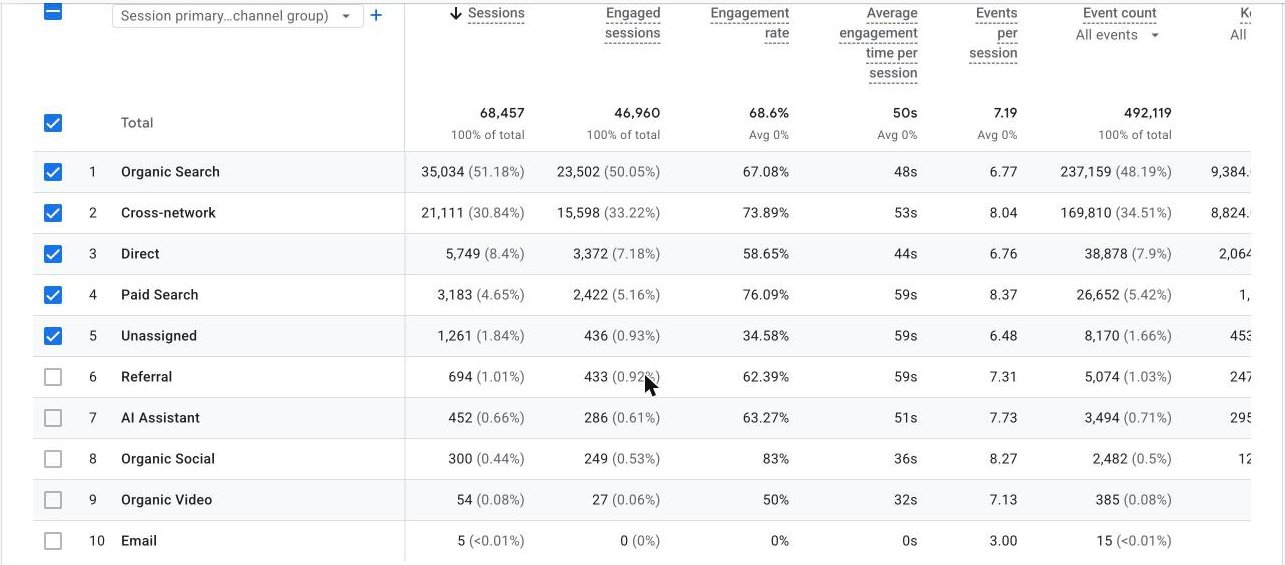
Visits from Claude usually show in analytics with claude.ai as the referral source.
- In Google Analytics 4, open Reports, then Acquisition, then Traffic acquisition.
- Set the dimension to "Session source / medium" and search for "claude".
- Check which landing pages those visits reach and whether they turn into enquiries.
- Add "Claude or another AI tool" to your "how did you hear about us?" form, since some visits arrive without a referral source.
Our guide on how to track AI traffic on your website covers free and paid tools for every AI platform.
FAQ
Is Claude free to use?
Yes, there is a free version of Claude. You can sign up at claude.ai or in the Claude app and use it for free with daily usage limits. Paid plans give higher limits, access to more models and extra features.
Is Claude Pro worth it?
Claude Pro suits people who use Claude most days for work, such as writing, research or analysis, and keep reaching the free plan's limits. If you use Claude now and then, the free plan is usually enough. Claude Max offers much higher usage limits again, and is worth it mainly for heavy daily users, such as people who rely on Claude for long research or coding sessions. For teams, Anthropic's business plans add shared workspaces and admin controls.
Is Claude the best AI?
No single AI assistant is best for everything. Claude is widely rated for writing, careful reasoning, analysing long documents and coding. Other assistants have their own strengths, such as image and video tools or close links to a search engine. The best choice depends on the tasks you use it for, and many businesses use more than one.
What is an artifact in Claude?
An artifact is a piece of work Claude creates in its own window beside the chat, such as a document, a piece of code, a chart, a diagram or a small interactive app. You can view, edit, download or share it, which makes artifacts useful for drafting reports, building simple tools or creating visuals for your business.
Can Claude generate images?
Claude does not create photographic images in the way dedicated image generators do. It can create visuals through code, such as charts, diagrams, illustrations and designs, and it can read and analyse images you upload.
Can Claude analyse video?
Claude can analyse images, screenshots, PDFs, spreadsheets and documents. Support for analysing video files directly has been limited, so check Anthropic's current features. A common workaround is to share a transcript or key frames from the video for Claude to analyse.
Is Claude more ethical than ChatGPT?
Both Anthropic and OpenAI publish safety policies and rules for how their assistants should behave. Anthropic guides Claude with a published set of principles, sometimes called its constitution, which sets out the values Claude should follow. Whether one assistant is more ethical than another depends on what you value, so it is worth reading each company's published policies yourself.
Is Claude safe for business information?
Anthropic's business and team plans do not use your conversations to train its models by default. On personal plans, you can choose in your settings whether your chats help improve Claude. Check Anthropic's current privacy policy and your own data rules before sharing confidential information.
Does Claude search the internet?
Yes. With web search turned on, Claude searches the web for current information and cites its sources inline.
Do I need to pay to appear in Claude's answers?
No. Your business appears in Claude's answers because of your website, rankings, reviews and mentions across the web.
Should I block AI crawlers like ClaudeBot?
Blocking ClaudeBot stops your content being used for training, while blocking Claude-SearchBot and Claude-User stops Claude reading your pages for search answers. If you want to appear in Claude's answers, allow the search and user crawlers at the very least.
How long does it take to rank in Claude?
Once your pages are indexed and crawlable, Claude can start citing them within a few weeks. Being recommended consistently usually takes three to six months, as reviews, PR coverage and rankings build up. Want to know what Claude says about your business today? Book a call with Team MAAI.