
Not long ago, a B2B purchase started with a conversation. A buyer rang a few suppliers, asked a sales rep for a brochure and a price, met people at a trade show and relied on the rep to explain the options. That has changed. Today the first conversation happens with Google and with AI tools such as ChatGPT. Buyers research on their own, ask AI to compare suppliers and build a shortlist before they speak to anyone: 6sense found that buyers now make first contact 61% of the way through their buying process, and 94% of buying groups already have a favourite by then. Search results and AI answers now do the job the sales rep used to do: explaining the problem, the options and who to trust. B2B SEO and answer engine optimisation (AEO) are how your business takes part in that first conversation. This guide explains how the B2B customer journey has changed, what buyers see in Google and AI answers at each stage, and how to do B2B SEO and AEO step by step.
What do B2B SEO and AEO mean in 2027?
What is B2B SEO?
B2B SEO (search engine optimisation) helps your website rank in Google and Bing when other businesses search for what you sell, from early questions such as "what is a 3PL" to supplier searches such as "3PL warehouse UK".
What is B2B AEO?
B2B AEO (answer engine optimisation) helps your business get cited and recommended inside AI answers, in ChatGPT, Perplexity, Claude, Gemini and Google's AI Overviews and AI Mode, when buyers ask those tools to explain a problem or suggest suppliers. You will also hear it called generative engine optimisation (GEO); our guide to B2B AEO and GEO strategy covers it in depth.
How do SEO and AEO work together in B2B?
AEO depends on SEO. AI tools search the web before they answer, and in our study of 42 business searches, 71% of the sources Google's AI Overviews cited already ranked on Google's first page for the same search. SEO gets your pages found; AEO makes them the passage an AI tool quotes and your business the one it names.
To see why both now matter so much, start with how the journey itself has changed.
What is the B2B customer journey, and how has it changed in 2027?
The B2B customer journey is the path a business takes from first noticing a problem to choosing a supplier, signing and renewing. In 2027 most of that path happens online, in Google and AI tools, before the buyer speaks to any supplier.
What are the stages of the B2B customer journey?
Gartner describes six "buying jobs" that every B2B buying group has to complete. They rarely happen in a straight line: different people work on different jobs at the same time and go back to earlier ones as they learn more.
We have a problem worth solving.
What are our options?
What exactly do we need, and what will it cost?
Who can do it for us?
Can we trust them?
Does everyone agree?
Here is what each stage looks like for a company choosing a logistics partner, and what SEO and AEO should give the buyer there.
| Stage | What the buying group asks | Where they look | What SEO and AEO should give them |
|---|---|---|---|
| Problem identification | "Why are our delivery costs rising?" | Google, AI answers, industry articles | Guides that explain the problem, written to be quoted by AI |
| Solution exploration | "What is a 3PL?" "3PL vs in-house fulfilment" | AI Overviews, ChatGPT, trade bodies, YouTube | The clearest explainer in your niche, a short video, a trade body listing |
| Requirements building | "How much does a 3PL cost?" | Cost guides, portals, Reddit, AI answers | Honest pricing and checklist pages |
| Supplier selection | "3PL warehouse UK" "Which 3PLs work with Shopify?" | Google results and map, ChatGPT shortlists, directories | Service, industry and location pages that rank, a complete Google Business Profile |
| Validation | "[Your company] reviews" | Your website, reviews, LinkedIn, AI summaries of your brand | Case studies with numbers, reviews, consistent facts everywhere |
| Consensus creation | Finance, IT and operations each check their own concern | Pages shared internally, comparisons, AI answers | An answer page for each role that is easy to forward |
Most B2B websites only cover supplier selection and validation. The first three stages are where favourites form, before you know the buyer exists.
Who is involved in a B2B buying decision?
A buying group, plus people outside it. Forrester's State of Business Buying 2026 found that, on average, 13 internal stakeholders and nine external participants influence a B2B purchase, each with their own questions.
Many B2B companies also miss a second audience: the customer's customer, the people your client serves. They never sign the contract, but what they search for shapes the buyer's view. For example, when one of our clients, a corporate relocation company, wrote guides answering relocating employees' questions about visas, housing and schools, those guides brought in 100% of its qualified leads from HR and mobility teams between February and June 2026.
"B2B has two customer sets: the direct customer, and the customer of the customer. If a relocation company has a strong reputation for moving employees well and is active online solving their queries, it has a far better chance of closing the deal with the mobility team." Kriti, founder, MAAI
How has the B2B customer journey changed?
It has moved from sales-led to self-led. Buyers used to rely on a supplier's sales rep to explain their options. Now they work through most of the six stages alone, in Google and AI tools, and bring a shortlist to their first sales call.
| Then: sales-led | Now: search-led and AI-led | |
|---|---|---|
| Where research starts | A phone call, a trade show or a referral | Google, ChatGPT, Perplexity and peers on LinkedIn or Reddit |
| Who explains the options | The supplier's sales rep | Search results, AI answers, review sites and trade bodies |
| When suppliers hear about it | At the start | 61% of the way through (57% in the UK and Ireland) |
| How the shortlist forms | From the reps the buyer has met | From what ranks, what AI names and what peers recommend |
| How suppliers are checked | References and meetings | Website, case studies, reviews, LinkedIn and AI summaries, before any call |
The shift started before AI. In 2018, Gartner found that B2B buyers spent only 17% of their buying time meeting potential suppliers. AI tools have pushed that further: buyers now ask ChatGPT the questions they once asked a rep.
"There are younger companies that need your service but have no relationship with you and no right contacts. They will find you online, and they will verify you online before they ever call. That is why an active website matters more now than it ever did." Kriti, founder, MAAI
So what do buyers actually find when they research in Google and AI tools? We checked.
What do B2B buyers see in Google and AI answers at each stage of the journey?
It depends on the stage. In our study, early learning searches were answered almost entirely by AI Overviews citing trade bodies, Wikipedia and video, while supplier searches were dominated by Google's local map and supplier websites.
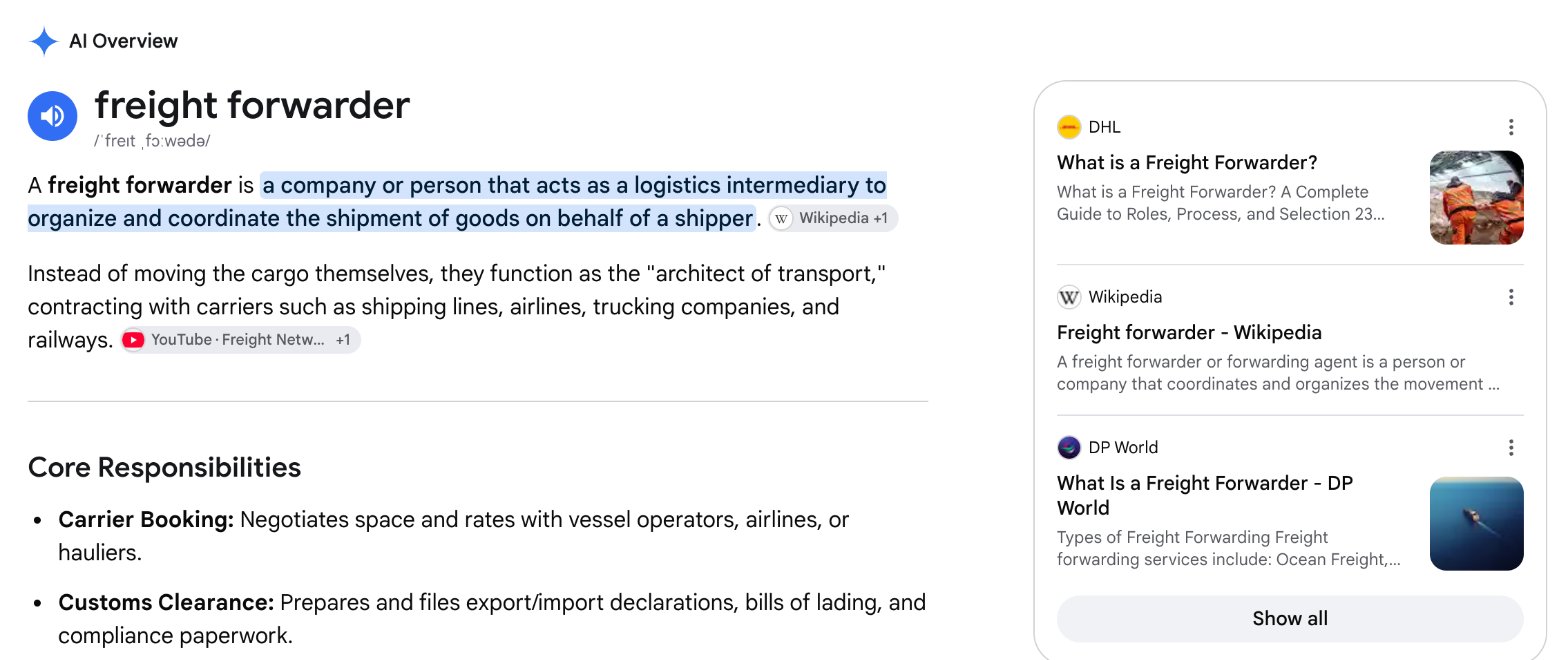
- Learning searches are answered by trade bodies, Wikipedia and video. Every one showed an AI Overview citing at least one non-supplier, such as ASCM, CIPS, Wikipedia, YouTube, GOV.UK sites or Forbes. To appear, publish the clearest explainer in your niche, add a short video and get listed by your trade bodies.
- Comparing searches lean on portals and advice sites such as Rightmove, Zillow, the HomeOwners Alliance, Which? and Reddit. Publish clear pricing and "how to choose" pages and keep your portal profiles complete.
- Supplier searches are won on page one and on the map. Three in four showed Google's local map, and around half of their AI Overviews cited only suppliers. Service, industry and location pages and your Google Business Profile do the work here.
This is also why every B2B company now needs both SEO and AEO, not just a good website.
Why do B2B companies need SEO and AEO in 2027?
Because buyers now complete most of their research before they contact anyone, and that research happens in Google and AI tools. If you are not visible there, you are rarely on the shortlist.
Why does a B2B company need SEO?
Because buyers verify every supplier online, even after a referral, and new buyers with no contacts find suppliers through search. Forrester found in 2023 that millennials and Gen Z make up 64% of business buyers and trust third-party content more than vendor material.
Why does a B2B company need AEO?
Because AI answers now sit on most business searches (36 of the 42 in our study), and Forrester reports that generative AI tools were the most cited meaningful interaction for researching B2B purchases in 2025. AI builds the shortlist; your website then has to pass the check, since TrustRadius found that 94% of software buyers who used AI went on to fact-check it.
Why are B2B search terms easier to win?
They are smaller and more specific than consumer searches, so fewer competitors fight for them. "B2B SEO" itself has a keyword difficulty of 19 out of 100 in the UK, against 47 in the US. Niche B2B searches are often smaller and less competitive still, and one search can carry a contract worth far more than its volume suggests.
How is B2B SEO and AEO different from B2C?
| B2B SEO and AEO | B2C SEO and AEO | |
|---|---|---|
| Buyer | A buying group of 10 or more people | Usually one person |
| Journey | Six buying jobs over months | Minutes to days |
| Searches | Low volume, specific, high value | High volume, broad |
| What AI cites | Trade bodies, explainers, directories, case studies | Reviews, retailers, product pages |
| Success measure | Qualified leads, pipeline, contract value | Revenue and conversion rate |
If you also sell to consumers, our guide to SEO for B2C brands covers that side. Here is how to put B2B SEO and AEO into practice.
How to do B2B SEO and AEO: 9 steps
Work through these in order. Steps 1 and 2 tell you what to build, steps 3 to 6 build it on your website, steps 7 and 8 build your authority beyond it, and step 9 tells you whether it is working.
- Find the questions your buyers ask at each stage
- Map keywords to each buying job
- Fix technical foundations for search and AI crawlers
- Build pillar pages for each service, industry and location
- Write answer-first content with BLUF and link it into topic clusters
- Add proof to every page
- Earn backlinks and mentions through digital PR
- Build your presence on LinkedIn, YouTube, Reddit and X
- Track AI visibility, leads and pipeline
Step 1. Find the questions your buyers ask at each stage
Ask your own team first, then check Search Console. Sales calls, enquiry emails and support tickets show the questions each member of the buying group asks. Search Console shows the questions people already use to find your site.
- Open the report
Search Console > Performance > Search resultsSet the date range to the last 3 months.
- Add a query filter
Click "+ Add filter", choose Query, and switch the match type to "Custom (regex)".
- Paste the pattern below and apply it
You now see every question-style search that showed your site, with impressions, clicks and position.
- Sort by impressions
Questions with high impressions and a position worse than 10 are your quickest wins: you are visible but not yet the best answer.
^(what|how|why|which|who|when|where|is|are|can|does|do|should|best)\bStep 2. Map keywords to each buying job
Group keywords by buying job and judge them by deal value, not volume alone. A search with 30 monthly visitors can be worth more than one with 3,000 if the right company is behind it.
- Start with your core service
Semrush > Keyword Magic ToolEnter a seed such as "3pl" and choose your country database.
- Pull the questions
Click "Questions" for problem identification and solution exploration searches, such as "what is a 3pl".
- Filter by intent
Informational for learning and comparing content; Commercial and Transactional for service and location pages.
- Check the results page
Open the SERP view for each keyword to see if it shows an AI Overview, the local map or video. That tells you whether to write an explainer, build a service page or record a video.
- Find gaps
Organic Research > competitor domain > PositionsFiltered by intent, this shows supplier searches they rank for and you do not.
Step 3. Fix technical foundations for search and AI crawlers
Search engines and AI crawlers have to be able to reach, read and trust your pages before anything else works.
- Key pages indexed in Google Search Console and Bing Webmaster Tools (ChatGPT search uses Bing's index).
- robots.txt and your firewall or CDN allow Googlebot, Bingbot and the AI search crawlers: OAI-SearchBot, PerplexityBot and Claude-SearchBot.
- Service details in the page HTML, not only loaded by JavaScript, because many AI crawlers do not run scripts.
- Core Web Vitals passed on mobile, and nothing important more than three clicks from the homepage.
- Organisation, service, article and FAQ schema markup, with the same company facts everywhere.
Step 4. Build pillar pages for each service, industry and location
A pillar page is the main page on a topic: one for each service, each industry you serve and each location or market. These win supplier searches, and they are the pages every related article links back to. Because three in four supplier searches in our study showed the local map, pair each location page with an accurate Google Business Profile.
Step 5. Write answer-first content with BLUF and link it into topic clusters
Use BLUF, short for "bottom line up front", a writing rule that started in US Army communications and that Ahrefs recommends for AI search: put the answer in the first sentence, then the detail the reader needs, then the background. AI tools tend to quote from the top of a page and the top of each section, so a BLUF opening is the passage most likely to be lifted into an answer.
We are a leading provider of innovative logistics solutions with decades of experience serving clients across a wide range of industries.
A 3PL (third-party logistics provider) stores your stock, picks and packs orders and ships them to your customers. We run [number] warehouses in [locations], integrate with Shopify and Amazon, and handle returns.
Then organise that content into topic clusters. Each pillar page from step 4 sits at the centre, and the cluster articles around it answer one question each, one for every buying job: the explainer, the cost guide, the comparison, the checklist. Every cluster article links to the pillar and to its neighbours with descriptive anchor text, and the pillar links out to each of them. Internal links tell Google and AI tools which page is your main answer on a topic, and a complete cluster shows that you cover the subject in depth, which is what builds topical authority.
Step 6. Add proof to every page
Case studies with numbers, reviews on independent sites, accreditations, client logos where allowed and named team members. Put proof on service pages, not only on a case study page, because that is where buyers validate you, and AI tools describe your brand from what they find.
Step 7. Earn backlinks and mentions through digital PR
Backlinks from relevant sites still help pages rank, and mentions of your brand across the web help AI tools recognise and recommend you. When Ahrefs analysed 75,000 brands, web mentions had the strongest link with appearing in Google's AI Overviews (a correlation of 0.664), well ahead of the number of backlinks (0.218). For B2B, aim for both, from the sites your buyers and AI tools already trust.
- Publish original data and pitch it. A survey, a pricing benchmark or a study like ours gives journalists and bloggers a reason to cite you. Pitch it to trade publications and industry newsletters.
- Get listed by trade bodies and directories. In our study, trade bodies such as ASCM, CIPS and FIATA and directories such as WhichWarehouse were cited in AI Overviews. Membership pages and directory listings bring links and mentions in one go.
- Offer expert comment. Answer journalist requests and write guest articles for trade publications, with a named expert from your team.
- Use partner and supplier pages. Software partners, accreditation bodies and suppliers often list the companies they work with. Ask to be included.
- Build free tools. A cost calculator or checklist that your industry links to earns links for years.
Relevance matters more than volume: one link from a respected publication in your sector does more than many links from unrelated sites.
Step 8. Build your presence on LinkedIn, YouTube, Reddit and X
B2B buyers research on social platforms as well as in search, and AI tools cite these platforms too: YouTube appeared in 9 of the 36 AI Overviews in our study, and Reddit in 5.
- LinkedIn. Complete your company page with your services, industries and locations in the words buyers search. Founders and team members who share real lessons and results build the familiarity that decides shortlists.
- YouTube. Turn your best explainers into short videos that answer one question each. They can appear in Google results and AI Overviews.
- Reddit and industry forums. Answer questions in the communities your buyers use, as a named person, without selling. Buyers trust peer advice, and AI tools often cite these threads.
- X. Useful for industry conversations and for reaching journalists. Grok also draws on posts from X.
Treat each guide as source material: one article can become a LinkedIn post, a short video and a thread, all pointing back to your pillar page.
Step 9. Track AI visibility, leads and pipeline
Check what AI tools say about you every month, and measure SEO and AEO in qualified leads and pipeline.
AI visibility: take ten questions from step 1, run them in ChatGPT, Perplexity, Gemini and Google's AI Mode each month, and record whether your business is named, which competitors are named and which websites are cited. The cited websites become your target list for step 7. Our guide to generative engine optimisation for B2B explains this in more detail.
- Mark enquiries as a key event
GA4 > Admin > Data display > EventsFind your form event (for example generate_lead) and switch on "Mark as key event".
- Give AI traffic its own channel
GA4 > Admin > Data display > Channel groups > Create new channel groupAdd a channel called "AI assistants" with the condition Source matches regex (pattern below), and move it above Referral.
- See which pages bring enquiries
Reports > Engagement > Landing pageFilter to Organic Search or your AI assistants channel, with your enquiry event in the Key events column.
- Capture the source in every form
Add hidden fields for landing page URL and traffic source, filled automatically by your developer or form tool, and map them to CRM properties such as "First landing page" and "Lead source". This works with HubSpot, Salesforce, Pipedrive or any CRM that accepts hidden fields.
- Report on pipeline
Group deals by lead source and first landing page each month.
.*(chatgpt|openai|perplexity|gemini\.google|claude|copilot).*Also ask every enquiry: "Where did you first hear about us?", with Google, ChatGPT or another AI tool, LinkedIn and referral as options. Buyers who first meet you in an AI answer often return later through a branded search, so analytics alone undercounts AEO.
How much should a B2B company spend on SEO and AEO?
Work it out from the value of a new client. Here is a worked example with illustrative figures for a B2B IT services firm.
Use your own client value and close rate, in any currency. If the number of enquiries you need looks realistic for your market, the budget makes sense. If you need leads while SEO and AEO build, our guide to SEO vs PPC for B2B explains how paid search fits alongside them. Set up tracking first with our guide on how to track AI traffic on your website.
How long does B2B SEO and AEO take to work?
In our experience, rankings and impressions start to move within three to six months, and qualified leads follow as pages climb for supplier searches. Refreshed pages that already rank can appear in AI answers within weeks. For the relocation client mentioned above, daily search impressions grew from about 700 to about 2,600 between January and May 2026. Here is a typical timeline from our client work. It varies with how competitive your market is and how much of your site already ranks. Our guide to whether SEO can generate leads covers how those leads are measured.
- 01Month 1
Audit the site, fix technical issues, map buyer questions for each stage, and set up GA4 and CRM tracking.
- 02Months 2 to 3
Pillar pages and the first cluster articles go live. New impressions start to show in Search Console, and refreshed pages can begin to appear in AI answers.
- 03Months 3 to 6
Rankings and impressions climb for question and supplier searches. The first organic and AI-sourced enquiries arrive.
- 04Months 6 to 12
Clusters are complete and digital PR builds mentions and links. Leads and pipeline from search and AI grow month on month.
How does B2B SEO and AEO differ by business model?
The nine steps stay the same, but the questions and the winning pages change.
| Business model | What buyers ask | Pages and sources that win |
|---|---|---|
| B2B SaaS | Best software for my use case, X vs Y, pricing, integrations | Comparison and alternatives pages, crawlable pricing, integration pages, software review platforms |
| Professional services | Who are the experts, what does it cost, how do I choose | Named expert guidance, sector pages, fee explanations, professional directories |
| Manufacturing | Materials, tolerances, certifications, lead times, minimum orders | A page per capability with specifications in the HTML, data sheets, quote requests |
| Logistics and supply chain | Routes, customs, warehousing, integrations | Capability and location pages, the clearest explainers in the niche, trade body listings, Business Profiles |
| Wholesale and B2B ecommerce | Products, specifications, trade terms | Category and product pages with trade pricing, minimum orders and delivery terms |
FAQ
What is B2B SEO and AEO?
B2B SEO helps your website rank in Google when businesses research what you sell. B2B AEO helps your business get cited and recommended in AI answers such as ChatGPT and Google's AI Overviews. Together they make you visible before buyers contact anyone.
How has the B2B customer journey changed?
It has moved from sales-led to self-led. Buyers now research through Google and AI tools and first contact suppliers 61% of the way through their buying process, usually with a favourite already in mind (6sense, 2025).
What are the stages of the B2B customer journey?
Gartner describes six buying jobs: problem identification, solution exploration, requirements building, supplier selection, validation and consensus creation. They overlap and repeat rather than following a straight line.
How is B2B SEO different from B2C SEO?
B2B SEO reaches a buying group and the customer's customer across a longer journey, with lower search volumes and higher deal values. B2C SEO reaches individual buyers who decide quickly.
How long does B2B SEO take to work?
Rankings and impressions usually start to move within three to six months, with qualified leads following as pages climb for supplier searches.
Do backlinks still matter for B2B SEO?
Yes. Relevant backlinks still help pages rank, and brand mentions across the web help AI tools recommend you. Digital PR built on original data, trade body listings and expert comment earns both.
How do I track leads from B2B SEO and AEO?
Mark enquiries as a key event in GA4, add an AI assistants channel group, and pass each lead's landing page and source into your CRM with hidden form fields.