

Most patients who need a physio, a scan, a hearing test or a private consultation start the same way: they search, compare a few names and, more and more often, ask an AI assistant who to book. Healthcare advertising in 2027 is about being the name that keeps showing up across those places, within rules that are stricter than in almost any other sector. This guide explains where healthcare ads work, which rules apply and why the clinics that win usually lead with search and use paid ads to support it.
What is healthcare advertising?
In plain English, healthcare advertising is how a clinic, hospital, pharmacy or health brand puts its name in front of people who need care. A private physio clinic bidding on "physio near me", a hearing care chain running a local radio slot and a health app promoting itself on Instagram are all healthcare advertising.
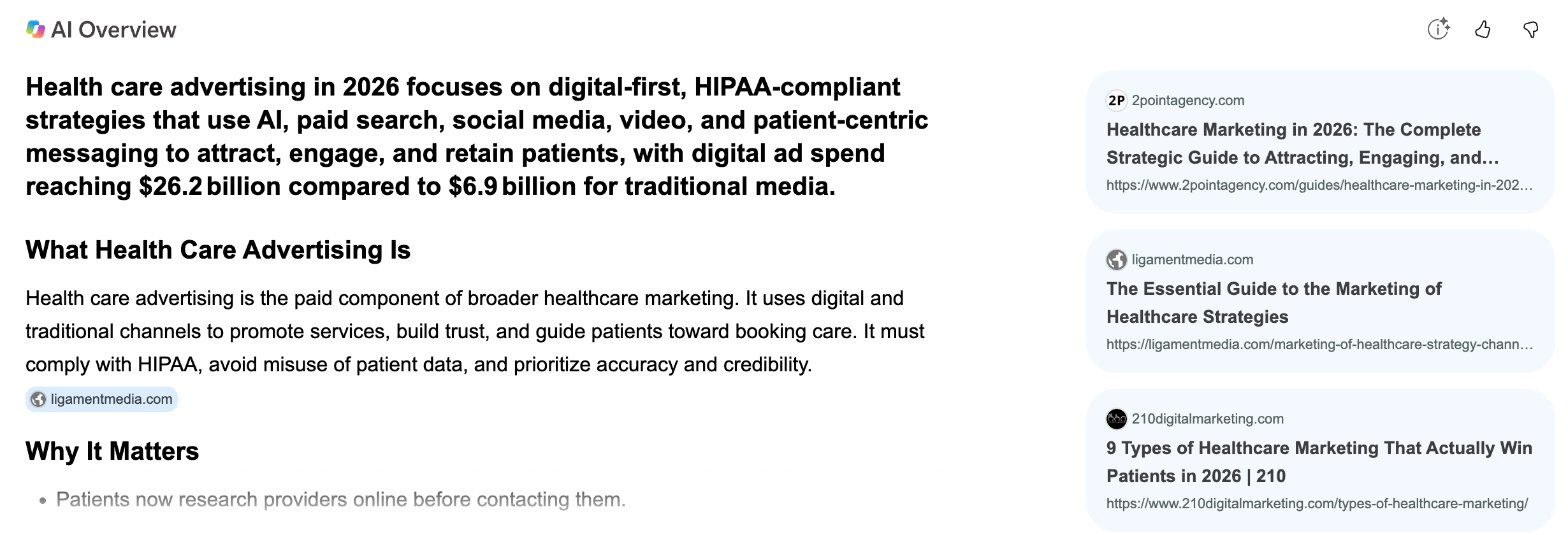
Ask a search engine what healthcare advertising means and you get a broad, mostly American answer. Bing's AI summary for "healthcare advertising" talks about HIPAA, the US patient privacy law, and lists paid search, social, video and display as the main channels. That is a fair start, but it says little about the rules outside the US or about how patients actually pick a provider.
This guide covers clinics and health brands in general. If you run a GP or specialist practice, our guide to digital marketing for doctors goes deeper on the medical rules, and our guide to medical spa marketing covers aesthetics clinics.
How do patients choose a healthcare provider in 2027?
Patients choose a healthcare provider by searching, comparing a short list on reviews, location and price, and checking the names they already trust. AI assistants now add another step: many people ask ChatGPT or Gemini for a shortlist before they ring anyone.
Trust still decides the booking. In a Pew Research Center survey of 5,111 US adults in October 2025, 85% said they get health information from healthcare providers at least sometimes and 60% from major health websites. Fewer used social media (36%) or AI chatbots (22%).
The chart shows that patients lean on sources they see as expert. The same survey found that 65% of people who use providers for health information rate them highly accurate, against 18% of AI chatbot users who say the same about chatbots. For your clinic, that means ads work best when they point to proof: qualified staff, clear prices, real reviews and pages that answer patient questions properly.
Which healthcare advertising channels work best?
The healthcare advertising channels that work best are the ones that catch patients when they are already looking: local map listings, organic search, AI answers and paid search. Social and display ads build awareness, but they reach people who are not yet ready to book and they face the tightest rules.
| Channel | Best for | What to watch |
|---|---|---|
| Google and Bing map listings | Local clinics: physio, dental, optician, hearing, private GP | Correct category, consistent address, steady reviews |
| Organic search (SEO) | Treatment and condition pages that patients research | Accurate, reviewed content with clear authorship |
| AI answers (ChatGPT, Gemini, AI Overviews) | Shortlists such as "best physio in Leeds" | Reviews, mentions on trusted sites, consistent details |
| Paid search (Google Ads, Microsoft Ads) | High-intent services with a clear price, such as scans or assessments | Health policies, no prescription-only medicine ads to the UK public |
| Paid social (Meta, TikTok) | Awareness, new clinic openings, events | Strict targeting limits and frequent ASA rulings |
| Offline (radio, posters, print) | Older audiences and local awareness | Same CAP Code rules as online ads |
Pick the two or three channels that match how your patients search. A single-site physio clinic gets most of its bookings from maps and organic search. A national health brand with a clear price for a scan or test can use paid search at scale.
How do you get patients from search and AI without relying on ads?
You get patients from search and AI by owning your map listing, building one strong page per treatment, collecting reviews and keeping your details identical everywhere. These are the same signals that local results and AI assistants use to decide which clinics to show.
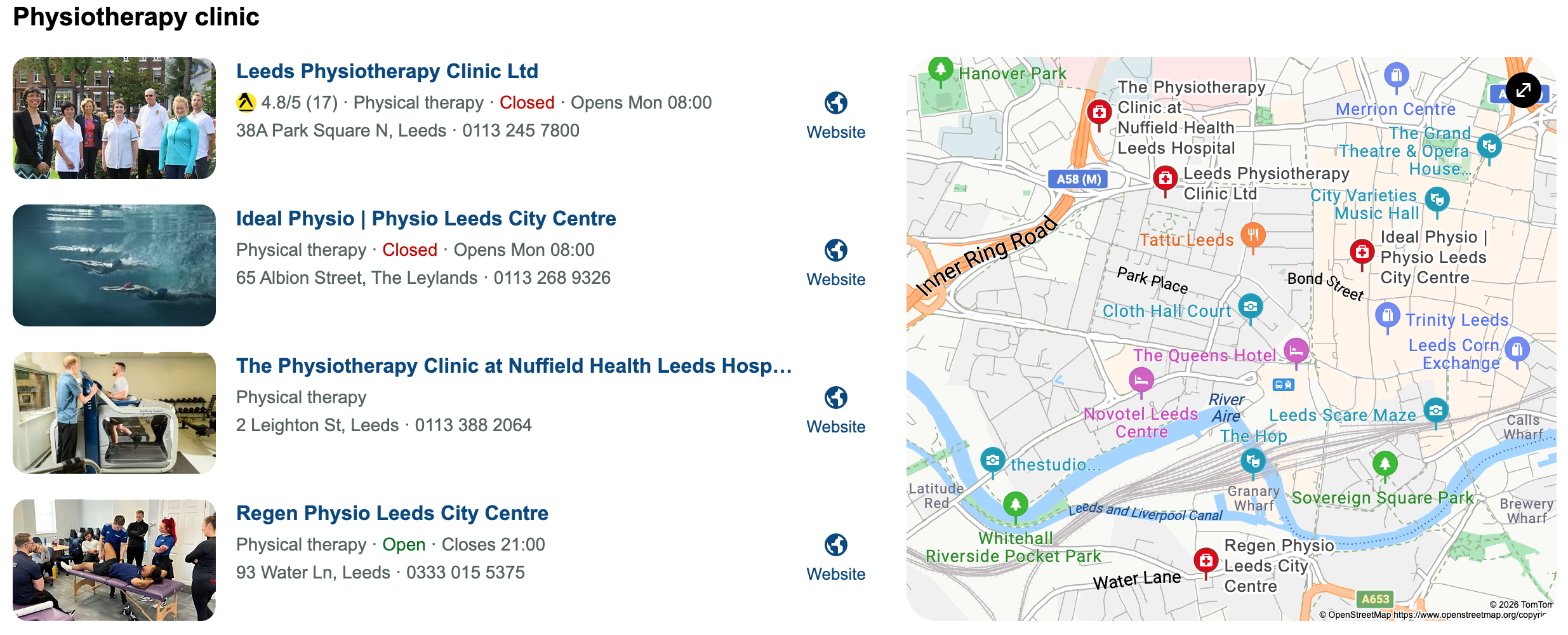
To see how this works in practice, we searched "physiotherapy clinic leeds" on Bing UK on 28 November 2026. Four clinics appeared in the local map listings. The only ad on the page was for a US online therapy service, which shows how little relevant paid competition there can be on local health searches.
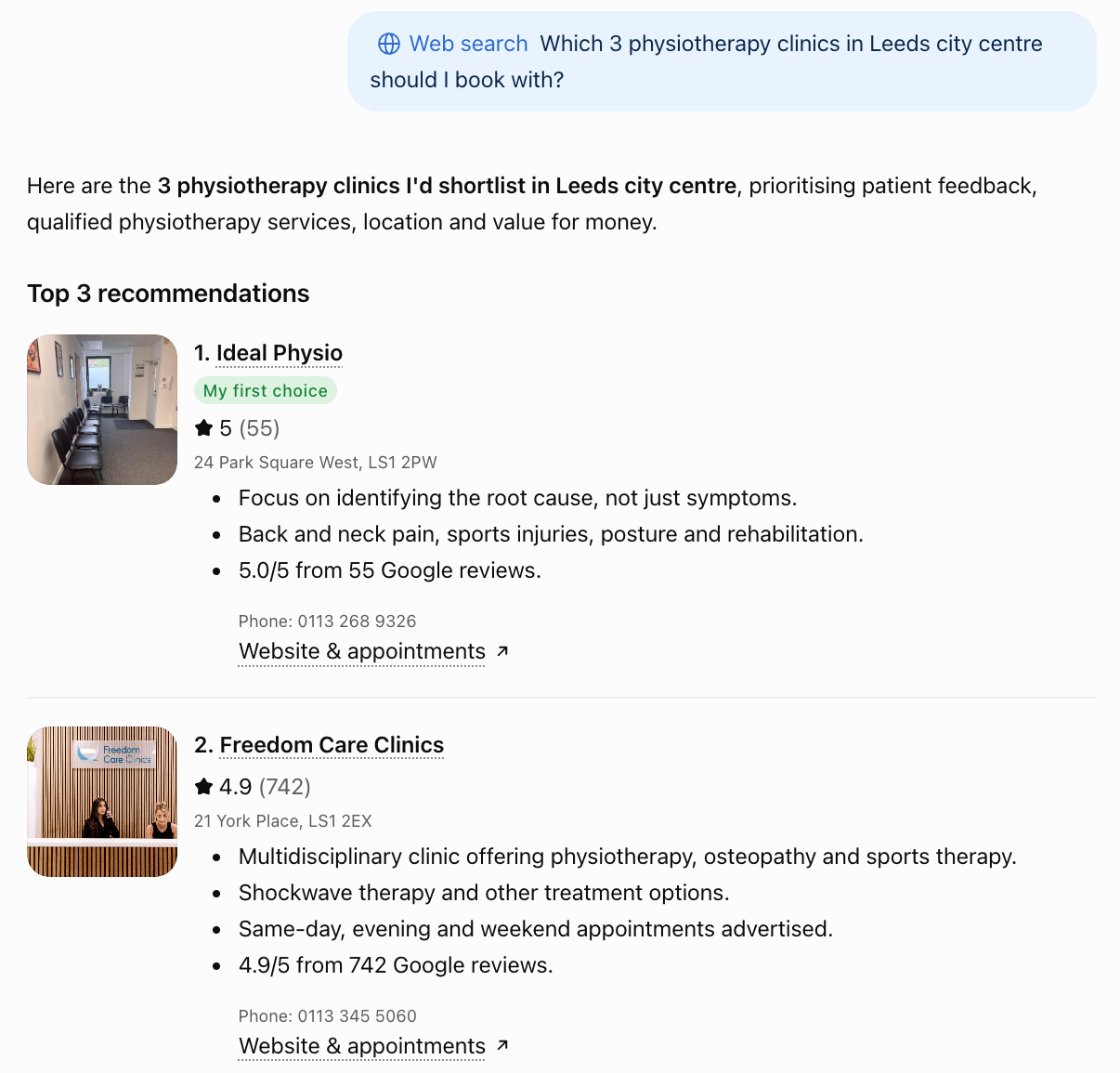
We then asked ChatGPT with web search: "Which 3 physiotherapy clinics in Leeds city centre should I book with?" It named Ideal Physio, Freedom Care Clinics and Leeds Physiotherapy Clinic, and quoted each clinic's Google rating and review count.
- Complete both map profiles
Google Business Profile and Bing Places > Edit profileUse the exact category ("Physiotherapist", "Hearing aid store", "Medical diagnostic imaging centre"), list every service and add opening hours, photos and prices where you can.
- Keep your details identical
Use the same clinic name, address and phone number on your website, map profiles, directories and booking platforms. Update every listing when you move.
- Ask every patient for a review
Send a short link after each appointment. Reviews that mention the treatment and location help maps and AI answers.
- Build one page per treatment
Explain who it is for, what happens, how long it takes, the price, who delivers it and their qualifications. Answer the questions patients ask before booking.
- Earn local mentions
Sports clubs, employers, local news and health charities are good places to be named. Mentions on trusted sites help AI assistants recommend you.
Our local SEO checklist covers the map work step by step, and our guide on how to rank in ChatGPT explains how AI assistants choose which businesses to name.
What are the rules for healthcare advertising in the UK and US?
Healthcare advertising rules require every claim to be honest and backed by evidence, ban some products from being advertised to the public and limit how you can use patient data. The details depend on the country, the product and the profession.
- Ad rules
- The CAP Code, enforced by the Advertising Standards Authority (ASA)
- Medicines
- Prescription-only medicines cannot be advertised to the public
- Devices and apps
- Medical claims need MHRA registration where it applies
- Professions
- Doctors, dentists and others also follow their regulator's guidance
- Ad rules
- The FTC requires truthful, evidence-based claims
- Medicines
- FDA rules govern prescription drug ads
- Patient data
- HIPAA limits how patient information is shared, including through tracking tools
- States
- Some states add their own rules for clinics and professions
- Google Ads
- Health policies restrict medicines, pharmacies and some treatments
- Targeting
- Google does not allow personalised ads based on health conditions
- Meta
- Health advertisers face limits on targeting and the data they can use
- Approval
- Some categories need certification before ads can run
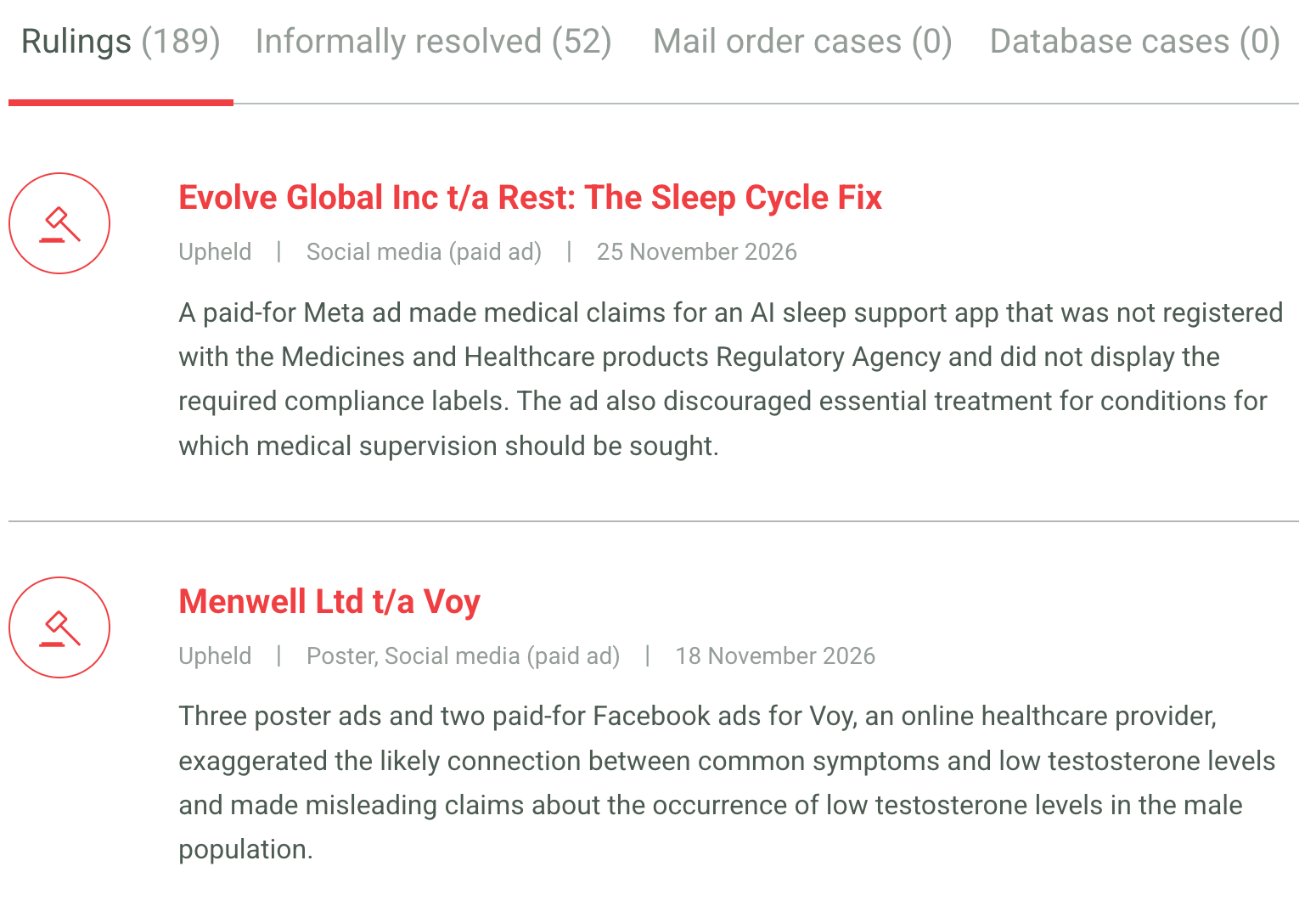
The ASA publishes its rulings every week, and health clinics appear often. A search of the ASA rulings database for "clinic" on 28 November 2026 returned 189 rulings. Of those, 63 involved paid social media ads and 11 involved paid search ads. Recent cases include a Meta ad for an AI sleep app making medical claims without MHRA registration, and Google search ads for weight-loss injections that promoted prescription-only medicines.
- Check every claim has evidence. If you say a treatment works, you need proof that would satisfy the regulator.
- Never name a prescription-only medicine in UK consumer ads. This includes indirect references such as "weight-loss jabs".
- Avoid pressure and fear. Countdown offers on surgery and ads that play on body image are common reasons for bans.
- Show who provides the care. Name the qualified professional and their registration where it applies.
- Check your tracking. Make sure booking forms and analytics tags do not send patient health details to ad platforms.
Where do paid ads fit in healthcare advertising?
Paid ads fit best as a top-up for high-intent services, new locations and quiet periods, once your map listings, website and reviews are in good shape. Ads stop the moment you stop paying, while search and AI visibility keep bringing patients in.
- A new clinic or location with no reviews yet
- Services with a clear price and urgent need, such as scans or same-day appointments
- Searches where organic results are crowded by big directories
- Seasonal demand, such as sports injuries or allergy clinics
- Testing which service pages convert before investing in content
- Sending clicks to a home page instead of the treatment page
- Broad targeting with no location limits
- Ads for treatments the platform restricts or the regulator bans
- No call tracking or booking tracking in place
- Running ads while the map listing has few or poor reviews
A simple way to set a budget is to work back from the value of a patient. As an illustrative example: if a new patient is worth £400 to your clinic over a year and one in four enquiries books, each enquiry is worth up to £100. If paid search brings enquiries for less than that, it pays. If it costs more, put the money into reviews, pages and local mentions instead. Our guide on UK SEO pricing explains what the organic side usually costs.
How do you measure healthcare advertising?
Measure healthcare advertising by booked patients and cost per booked patient for each channel, not by clicks or impressions. A cheap click that never books is worth nothing.
| Metric | What it tells you | Where to find it |
|---|---|---|
| Bookings by source | Which channels bring patients | Booking system source field, Google Analytics 4 |
| Cost per booked patient | Whether paid channels pay back | Ad platform spend divided by bookings |
| Calls and direction requests | How map listings perform | Google Business Profile > Performance |
| Organic clicks to treatment pages | Which services patients research | Google Search Console > Performance |
| AI mentions | Whether assistants name your clinic | The same prompts checked each month |
| Review count and rating | Trust signals for maps and AI | Google and Bing profiles |
To see visits from ChatGPT and other AI tools in your analytics, follow our guide on how to track AI traffic for free. Review the numbers monthly and move budget towards the channels that bring booked patients at a cost you can sustain.
FAQ
What is healthcare advertising?
Healthcare advertising is any paid or promoted message for a health service, treatment or product, such as search ads, social ads, sponsored listings, posters or broadcast ads. It sits inside wider healthcare marketing, which also includes SEO, reviews and content.
Can clinics advertise on Google Ads?
Yes, clinics can advertise on Google Ads, but health policies apply. Some treatments, medicines and pharmacies are restricted or need certification, and Google does not allow personalised ads based on health conditions. In the UK, prescription-only medicines cannot be advertised to the public at all.
Who regulates healthcare advertising in the UK?
The Advertising Standards Authority enforces the CAP Code for non-broadcast ads and the BCAP Code for TV and radio. The MHRA regulates medicines and medical devices, and professional regulators such as the GMC set extra rules for their members.
Is SEO or paid advertising better for healthcare?
Most clinics get the best long-term return from search: map listings, treatment pages and reviews keep bringing patients without paying per click. Paid ads work well on top for new locations, urgent services and testing demand.
How much should a clinic spend on advertising?
Work back from the value of a patient and your booking rate. If an enquiry is worth more to you than it costs to get through ads, the channel pays. Track cost per booked patient for each channel and adjust monthly.