

Ask any freight forwarder, courier or haulier what keeps them up at night and the answer is rarely the trucks. It is where the next contract comes from. Most logistics firms grow on referrals and a few big accounts, then hit a wall when one of those accounts leaves. Logistics leads are the enquiries, quote requests and tender opportunities that keep the pipeline full. This guide explains where logistics companies get clients in 2027, how to win leads from search, AI assistants and public tenders, why cold outreach needs to change, and how to turn a quote request into a signed account.
What are logistics leads?
In plain English, a lead is the start of a sales conversation. For a freight forwarder it might be an importer asking for a sea freight rate from Shanghai. For a courier it might be an online shop asking about next-day collections. For a haulier it might be a manufacturer with a regular full-load lane.
It helps to split leads into two groups. Inbound leads come to you: search, AI answers, your quote form, referrals. Outbound leads are ones you go after: tenders, partner networks and outreach. The firms with the steadiest growth run both, so one quiet channel never empties the pipeline.
This post focuses on getting clients and leads. For the wider brand and website plan, see our guides on logistics marketing and 3PL marketing.
Where do logistics companies get clients in 2027?
Logistics companies get clients from six main sources: search and AI answers, quote and booking forms, referrals and past clients, public and private tenders, partner networks, and targeted outreach. The right mix depends on your service. A local courier lives on map listings and repeat customers. An international forwarder relies more on agent networks and tenders.
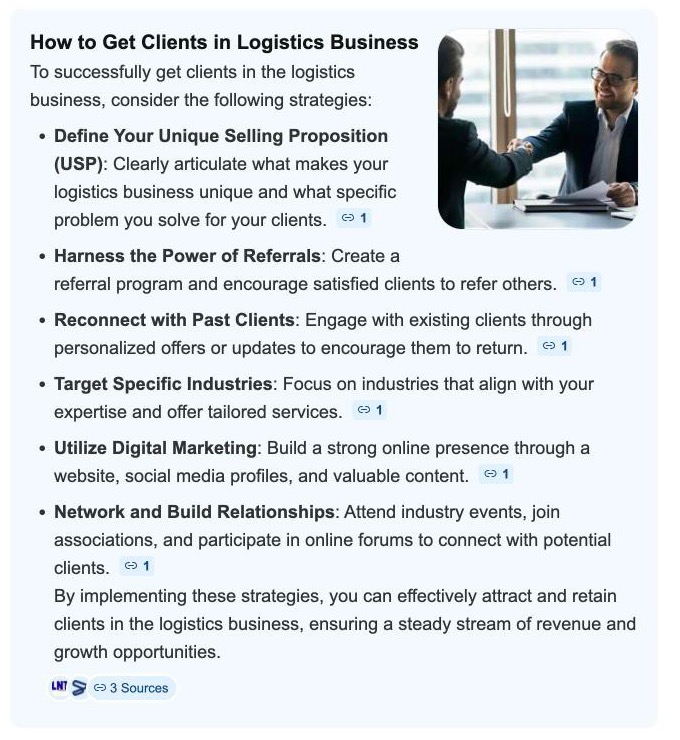
Bing's AI answer for "how to get clients for logistics business" lists the usual advice: a clear selling point, referrals, past clients, target industries, digital marketing and networking. It is a fair summary, but it stops short of where buyers actually look today and how to turn an enquiry into a contract.
| Lead source | Best for | What it takes |
|---|---|---|
| Google, Bing and map listings | Couriers, hauliers, local warehouses | A complete business profile, reviews, one page per service and area |
| AI assistants (ChatGPT, Gemini, Copilot) | Forwarders and specialist carriers | Reviews, mentions on trusted sites, clear service pages |
| Quote and booking forms | Every logistics firm | A short form, a fast reply and a named contact |
| Referrals and past clients | Firms with a strong service record | A simple referral ask and regular check-ins |
| Public tenders | Firms with compliance paperwork in place | Alerts, a bid library and capacity to respond |
| Partner and agent networks | International forwarders | Membership, reliability and reciprocal work |
| Targeted outreach | Firms with a clear niche | Relevant, specific messages to a short list |
The table shows where effort usually pays off. Pick two or three sources that suit your service and do them well before adding more.
How do you get logistics leads from Google, Bing and AI assistants?
To get logistics leads from search, you need to appear in three places: the local map listings, the normal search results and the shortlists AI assistants give. Each one picks providers in a different way, so a firm that wins one can be invisible in another.
Map listings on Google and Bing
When a shipper searches "freight forwarders manchester", the first thing they see is a map with a handful of firms. Those listings are driven by your business profile, your category, your distance from the searcher and your reviews.
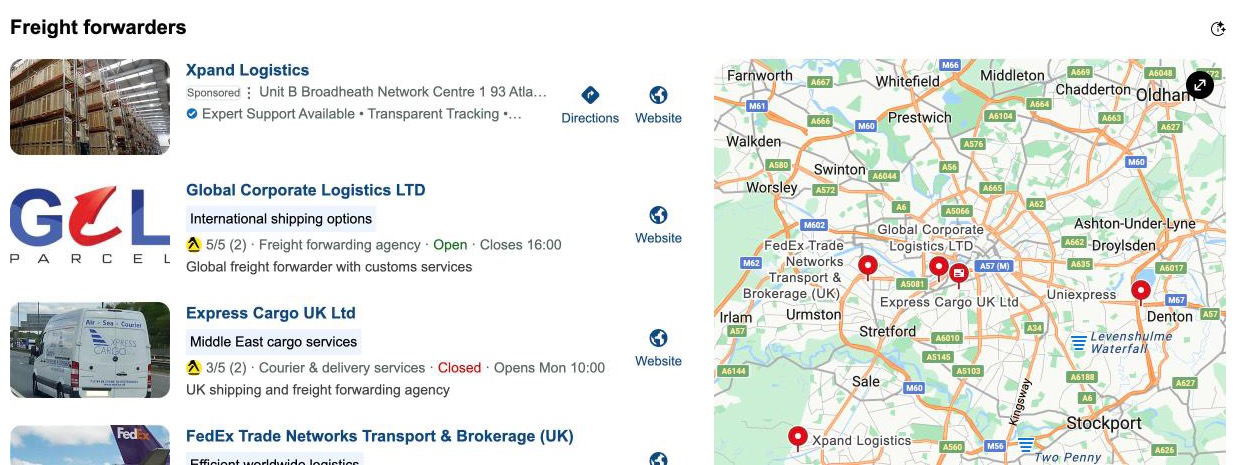
AI assistants such as ChatGPT
Buyers now ask AI assistants for a shortlist before they ask for quotes. We asked ChatGPT with web search: "Which 3 freight forwarders in Manchester should I ask for a quote?" It named three firms and said it had prioritised established operators with good review signals.
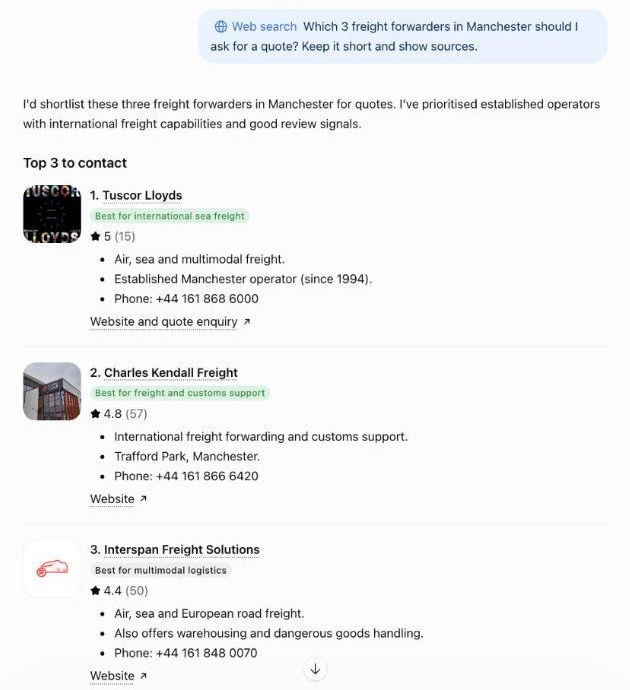
For your business, that means reviews and mentions on trusted sites do double duty. They help your map listing and they give AI assistants a reason to name you. Our guide on how to rank in ChatGPT covers the full process.
Service and lane pages on your website
Shippers search for the exact job they need: "pallet delivery to Ireland", "temperature controlled transport Birmingham", "air freight from India to UK". A page for each service and main lane gives you a chance to rank for those searches and gives AI tools a clear answer to quote.
How do you win logistics clients from public tenders?
Public tenders are one of the few lead sources where the buyer, budget and deadline are published for you. In the UK, central and local government contracts are listed on Find a Tender, and smaller contracts on Contracts Finder. Other countries run their own portals, such as SAM.gov in the US and TED in the EU.
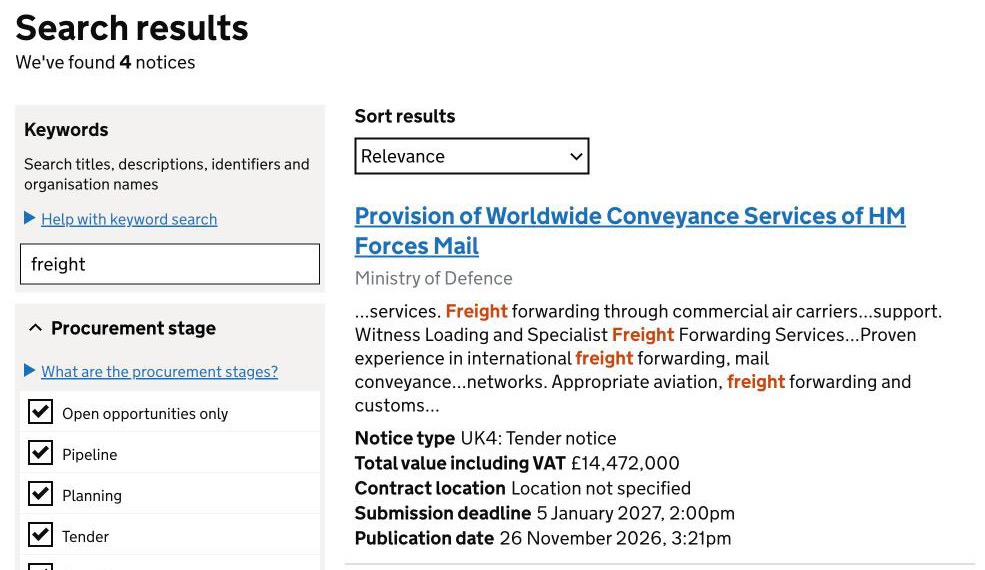
When we searched Find a Tender for "freight" on 28 November 2026, open notices included a Ministry of Defence contract for worldwide conveyance of HM Forces mail, worth £14,472,000 including VAT, with a submission deadline of 5 January 2027.
- Save searches with alerts
Find a Tender > Search > Keywords > Save searchCreate searches for your services (freight, courier, haulage, warehousing, cold chain) and turn on email alerts.
- Check the full notice
Read the lots, value, contract length, location and award criteria before you decide to bid.
- Build a bid library
Keep insurance certificates, accreditations, policies, fleet details and case stories ready to reuse.
- Bid where you can win
Smaller lots and regional contracts often suit a mid-sized firm better than a national framework.
- Ask for feedback
Request scoring feedback on every bid, win or lose, and improve the next one.
Tenders take time to win, so treat them as a steady long-term source rather than a quick fix. Many firms also win work as a subcontractor to a larger supplier that holds the main contract.
Does cold outreach still work for logistics leads?
Cold outreach still works for logistics leads when it is relevant, specific and sent to a short list of companies you can genuinely help. Generic mass emails now do more harm than good, because buyers remember who wasted their time.
The figures above show two things. Most buyers want to research on their own first, which is why search and AI visibility matter so much. And nearly three in four will avoid a supplier whose outreach is off the mark. Gartner also found buyers do want a seller's input when they are deciding whether a service fits their needs.
- Targeting firms that ship on lanes you already run
- Mentioning a specific trigger, such as a new warehouse, a new market or a seasonal peak
- Offering something useful, such as a lane rate check or a customs question answered
- A short message from a named person with a direct phone number
- Following up with a relevant case story, not a reminder
- The same template sent to every importer on a list
- Leading with your fleet size instead of their problem
- Pitching services the company does not use
- Long sequences with no new information
- Buying large contact lists with no fit check
LinkedIn works the same way. A useful post about a lane, a port delay or a customs change does more for your pipeline than connection requests with a sales pitch attached.
How do you get more logistics clients from referrals and partners?
Referrals and partners bring the warmest logistics leads, because someone the buyer trusts has already vouched for you. Most firms get some referrals by accident. The ones that grow ask for them on purpose.
How do you turn a logistics lead into a client?
You turn a logistics lead into a client by replying fast, qualifying the job properly and making the first shipment easy. Many leads are lost after the enquiry arrives, not before.
- Reply the same working day. A buyer asking for quotes is usually asking several firms at once.
- Qualify the lane and volume. Origin, destination, goods, weight, frequency and deadline tell you whether the job fits.
- Send a clear quote. Show what is included, transit time, terms and the next step in plain language.
- Offer a trial shipment. One successful load lowers the risk of switching for the buyer.
- Follow up with a named contact. Give one person who answers the phone and knows the account.
- Review after 90 days. Share performance, fix any issues and ask for the next lane or a referral.
If search is part of your plan, our guide on whether SEO can generate leads explains how to connect search visibility to real enquiries.
How do you measure logistics lead generation?
Measure logistics lead generation by what each source brings in revenue, not by the number of enquiries. Ten qualified quote requests on lanes you run well are worth more than a hundred one-off parcel enquiries.
| Metric | What it tells you | Where to find it |
|---|---|---|
| Leads by source | Which channels bring enquiries | CRM source field, Google Analytics 4 |
| Reply time | How fast your team responds | CRM or shared inbox timestamps |
| Quote-to-win rate | How many quotes become clients | CRM pipeline stages |
| Revenue per lead source | Which channels bring profitable work | CRM linked to invoicing |
| Map listing calls and clicks | How local search performs | Google Business Profile > Performance |
| AI visibility | Whether assistants name you | The same prompts checked each month |
To see visits from ChatGPT and other AI tools in your analytics, follow our guide on how to track AI traffic for free. Review the numbers monthly and move effort towards the sources that bring profitable, repeat work.
FAQ
How do I get clients for my logistics business?
Mix inbound and outbound sources. Build strong map listings, service pages and reviews so buyers find you in search and AI answers, then add tenders, partner networks and targeted outreach to firms that ship on your lanes.
Where can I find logistics leads for free?
Free sources include your Google Business Profile and Bing Places listing, public tender portals such as Find a Tender and Contracts Finder, referrals from past clients and useful LinkedIn posts about your lanes and services.
Should I buy logistics leads?
Bought lead lists are rarely a good fit, because the contacts have not shown interest in your service. Gartner found 73% of B2B buyers actively avoid suppliers who send irrelevant outreach, so a short, well-researched list usually performs better.
How long does it take to get logistics leads from SEO?
Map listings and reviews can bring calls within weeks. Ranking service and lane pages usually takes several months, and tenders often take longer again because of fixed bidding cycles.
What is a qualified logistics lead?
A qualified logistics lead has a real need you can serve: a lane you run, goods you can handle, a volume that makes sense and a timeline for starting.