

An occupier needs 20,000 square feet of warehouse space by spring. An investor wants a tenanted retail parade in the North West. A landowner wonders who could take a site through planning. Before any of them phones an agent or a developer, they search, scroll listings, read an AI answer and check who keeps appearing. Commercial real estate marketing is the work of being the name they see at each step. This guide shows agents and developers how to do that in 2027: the pages Google rewards, the listing details occupiers need, the proof that wins instructions and how to get named in AI answers.
What is commercial real estate marketing, and how is it different from residential?
Commercial real estate marketing promotes offices, industrial units, retail space, land and investment property to the businesses and investors who might lease or buy them. It differs from residential marketing because the buyer is a business, the decision takes months and several people have a say. Google's own AI Overview for the term says the same: commercial marketing relies on specifications, financial data, longer sales cycles and multiple decision-makers.
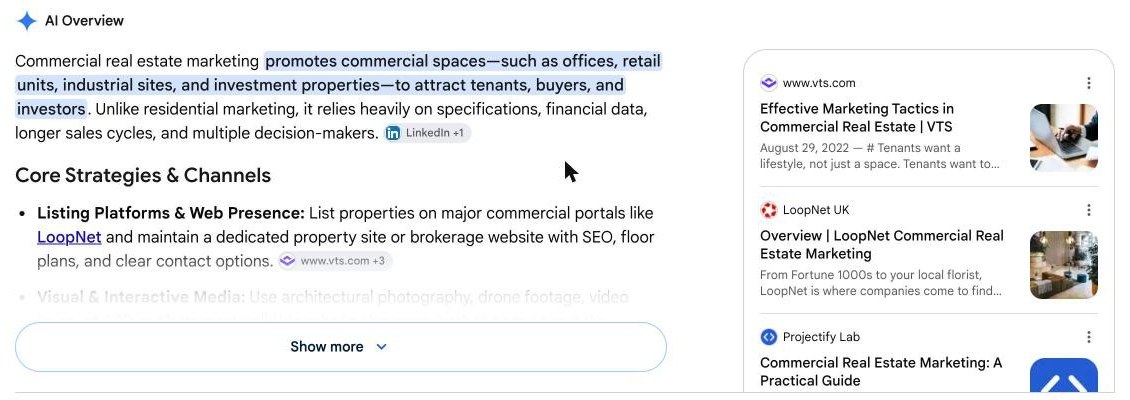
In plain English, a homeowner chooses a house they like. A commercial occupier chooses a location, a lease and a landlord. A finance director checks the numbers, an operations lead checks the loading bays and a managing director signs. Your marketing has to answer all three people. If you also work with homes, our guide to SEO for estate agents covers the residential side.
The term changes with the country. The UK says commercial property and commercial agents, while the US says commercial real estate and brokers. You will see both in this guide, and the steps are the same.
How do occupiers and investors find commercial property agents and developers?
They search in three places: Google, the property portals and AI assistants. Each one answers a different question. Google shows who covers a location, the portals show what is available and AI assistants shortlist firms and explain markets. A firm that appears in only one of these loses the other two.
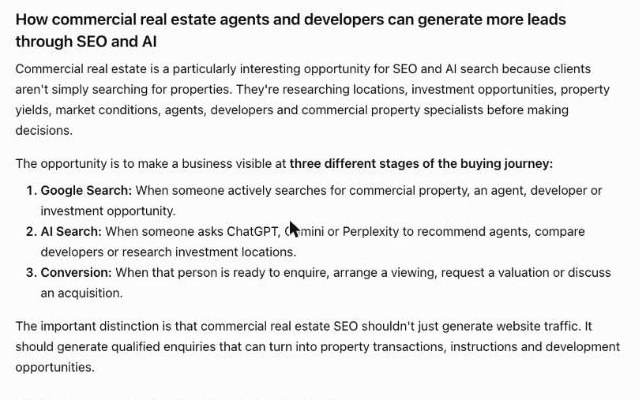
We asked ChatGPT how commercial agents and developers get more leads from search and AI. It framed the opportunity as three stages: being found on Google, being recommended in AI answers and turning that interest into an enquiry. That matches what we see in the results.
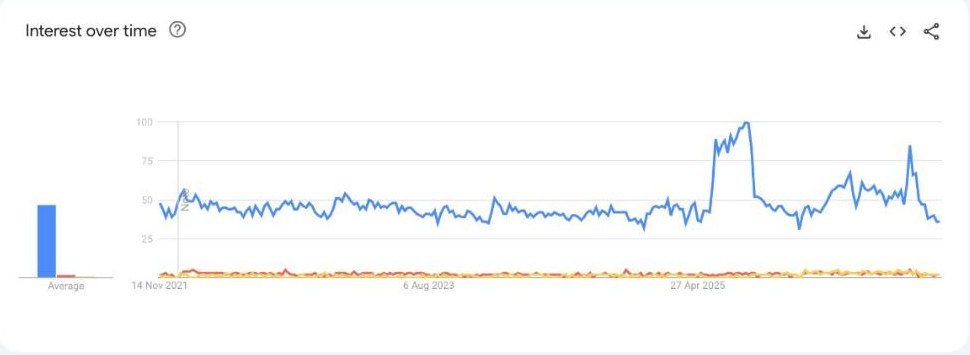
Search interest shows where the volume sits. In Google Trends for the UK over five years, "commercial property for sale" draws far more searches than "commercial property agents" or "commercial property investment". People search for the property first and the agent second. Your listing and location pages therefore carry most of the demand, and your agent or investment pages catch the buyers who are ready to choose a firm.
How do you get found for commercial property searches on Google?
You get found by giving Google a specific page for every search a buyer makes: a page for each location, each property type and each listing. A single "Commercial property" page cannot rank for "industrial units to let in Manchester" and "office space in Leeds" at once. Specific pages can.
How should you build commercial property listing pages?
Give every listing its own page on your own site, with a permanent web address, and keep the page up after the unit is let or sold. Show the property type, location, size, tenure, price or rent guide, planning use, floor plan, photos and a contact route. Remove or merge near-empty pages, because hundreds of identical listing pages with no detail add little.
Detail wins clicks. Rightmove's own research on commercial listings found that 54% of its commercial users would not click a listing marked price on application, and a further 24% would click only after looking at listings that showed a price. It also compared listings with and without extras, and the extras made a clear difference.
The figures are Rightmove's averages from 2021, so use them as a guide to what buyers value rather than a promise. The direction is clear: a floor plan, a virtual tour and a price give an occupier enough to shortlist a unit without calling. Copy the same detail onto your own listing pages.
How do location and property-type pages help you rank?
Location and property-type pages capture searches like "commercial property agents Manchester" and "warehouse for sale in the Midlands". Build one page for each place and property type you handle, and write each from real knowledge: the submarkets, rents, major occupiers, transport links and recent deals. Copying one template across 40 towns with only the name changed does not help the buyer or Google.
- Pick your patch. List the towns, business parks and property types where you can show real deals.
- Write the answer first. Open with who you act for, what you cover and what you have done nearby.
- Add proof. Include recent lettings or sales you can name, a short market note and a clear next step.
- Link the pages. Connect each location page to its live listings, its case studies and its service page.
How does the Google map pack work for commercial agents?
A search for "commercial property agents manchester" shows a map and a short list of firms before the ordinary results. Each firm needs its own Google Business Profile, with the correct category, address, hours, services and recent reviews. When we searched, the map listed one agent with 172 reviews at 4.1 stars, another with 11 reviews at 3.9 and a third with 3 reviews at 3.0. Review count is not the only signal, so keep your profile complete and collect reviews from landlords and tenants steadily.
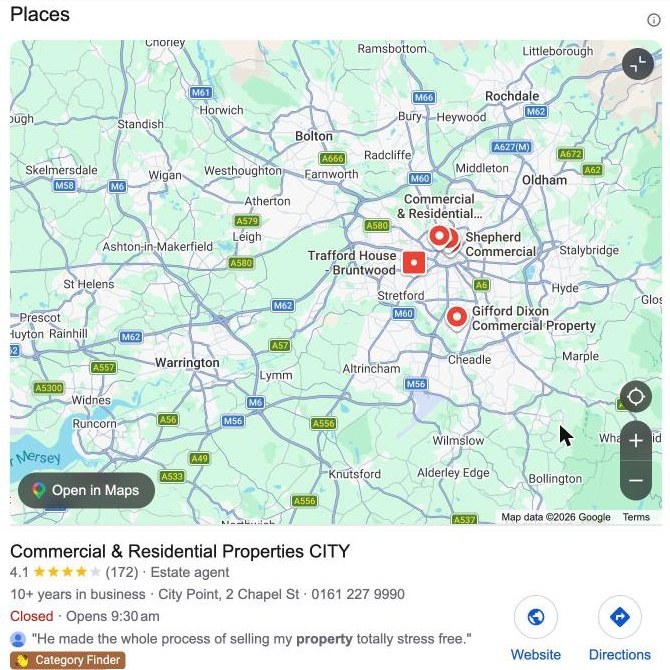
Multi-office firms should make one profile per staffed office and keep the name, address and phone number identical on the website and every directory. Our guide on how to rank in Google AI Overviews explains how Google reuses this local data in its AI answers.
How do case studies and market data win commercial instructions?
Case studies and market data win instructions because commercial clients are buying trust in a high-value deal. A landlord choosing who should let a building, or an investor choosing who should source an acquisition, wants evidence that you have done it before. Pages that show that evidence also give Google and AI tools something specific to quote.
- The property and the brief. Type, location and what the client wanted to achieve.
- The problem. For example a long void, a difficult lease or a site with planning risk.
- What you did. The marketing, the buyer or tenant search and the negotiation.
- The result. Letting or sale achieved, time taken and any figures the client has approved.
- A named contact. The partner or director who ran the deal, with a link to their profile.
Original market data goes further. A quarterly note on industrial rents in your region, vacancy in your town centre or yields by sector gives journalists, trade sites and investors a reason to cite you. Publish the numbers, explain how you collected them and keep the page updated so the figures stay current.
Be careful with client names and deal values. Only publish what the client has agreed, and describe a deal by sector and location where a name is not cleared.
How can commercial agents and developers get named in AI answers?
You get named in AI answers by ranking well, answering the question a buyer asks in the first lines of a page and being mentioned on other trusted sites. AI tools build answers from sources they can read and verify, so the same pages that win on Google also feed ChatGPT, Gemini and Google's AI Overviews.
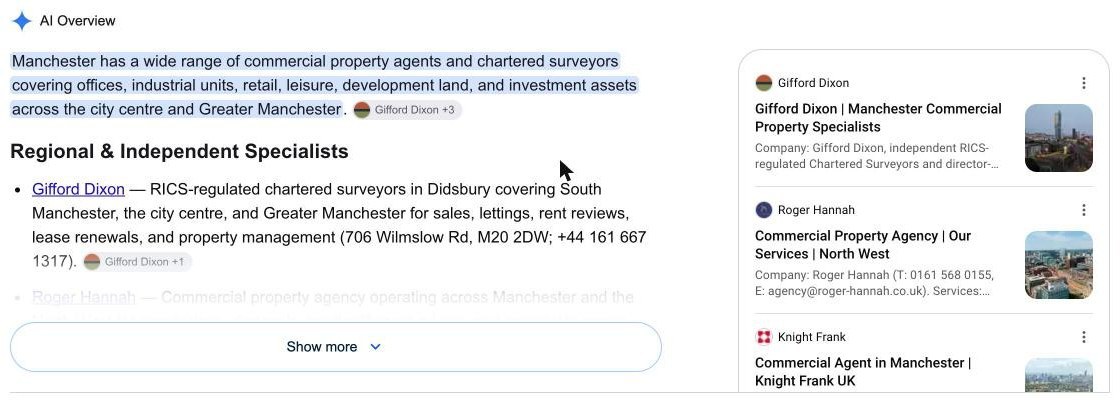
Google's AI Overview already names commercial firms. For "commercial property agents manchester" it listed regional specialists such as Gifford Dixon and Roger Hannah, then national consultancies such as Knight Frank, and linked to those firms' own pages. A firm without a clear, specific page about what it does in that city has little for the answer to draw on.
Ahrefs studied 1.9 million citations in Google AI Overviews and found 76% came from pages already ranking in the top 10. The Pew Research Center tracked 900 US adults across 68,879 Google searches in March 2025 and found people clicked a traditional result in 8% of visits when an AI summary appeared, against 15% when it did not. For you, that means ranking comes first, and being the named source matters more when fewer people click.
What should a commercial agent or developer do to appear in ChatGPT and AI Overviews?
- Answer the buyer's question first. Start a page with a direct answer in 40 to 60 words, for example what you charge, which sectors you cover or how a letting process works.
- Use the questions buyers ask. Write headings such as "How much do commercial agents charge?" and "What should you check before buying an industrial unit?".
- Name things precisely. Use your full company name, locations, property types and team names consistently across your site and profiles.
- Get mentioned elsewhere. Aim for trade press comment, industry association pages, directories and LinkedIn profiles for your partners.
- Allow the crawlers. Check your robots.txt and any CDN settings are not blocking search crawlers from your listing and guide pages.
Our guides on answer engine optimisation and how to rank in ChatGPT give the full steps, including how ChatGPT chooses its sources.
How should you market commercial property to occupiers, investors and landowners?
Market to each audience separately, because each asks different questions and needs different proof. A single message for everyone reads as generic to all of them. The table below shows how the same firm can speak to each group.
| Audience | What they search | Pages that help | Proof they want |
|---|---|---|---|
| Occupiers (tenants and buyers) | Office space in a town, warehouse to let, retail units for sale | Listing pages, location pages, fit-out and lease guides | Floor plans, photos, price or rent guide, transport and labour data |
| Investors | Commercial property investment, yields, tenanted retail for sale | Investment pages, market reports, sector guides | Yields, lease length, tenant covenant strength, past acquisitions |
| Landowners and developers | Sell land for development, planning consultants, development partners | Land and development pages, planning case studies | Planning wins, completed schemes, partners and timelines |
| Landlords | Who should let my building, commercial property management | Landlord services page, letting case studies | Time to let, rent achieved, marketing plan |
Developers should add pages for each scheme, with a plan, a timeline, unit sizes and a way to register interest. Agents should add a page for each service they sell, such as lettings, sales, valuations and lease advisory. Logistics and industrial specialists can look at our guide to logistics marketing for how those occupiers research suppliers.
Which channels work for commercial property marketing besides SEO?
Search works best alongside a few other channels that reach the same decision-makers. Pick the ones where your buyers already spend time, and use each to point back to your listing and location pages.
How do you measure commercial real estate marketing?
Measure the actions that lead to instructions: enquiries, viewings booked, valuation requests and instructions won, with the page or channel each came from. Traffic and rankings are useful signals, but a commercial deal can take months, so connect each enquiry to its source in your records.
- Enquiries by page type. Listing pages, location pages, service pages and guides.
- Viewings and valuations requested. Count them in GA4 as key events and match them to your customer records.
- Search Console clicks and impressions. Check the location and property-type queries you want to win.
- Map pack and review position. Note where each office appears and how many reviews it holds.
- AI visibility. Check whether Google AI Overviews and ChatGPT name you for your main searches.
Our step-by-step guide on how to track AI traffic for free shows how to set this up in GA4 and Search Console, and can SEO generate leads explains how to judge search by enquiries.
What is a 90-day plan for commercial real estate marketing?
A 90-day plan fixes the basics first, then builds proof and then widens your reach. Start with the pages and profiles buyers meet first, and add content once those are solid.
- Days 1 to 30: fix the foundations
Search Console > Pages > IndexingGive every live listing its own page with size, price guide, floor plan and photos. Claim and complete a Google Business Profile for each office, and check your site is crawlable.
- Days 31 to 60: build location and service pages
Write a page for each location and property type you handle, with real deals, market notes and a clear enquiry route. Add one case study for each service.
- Days 61 to 90: earn mentions and measure
GA4 > Admin > Events > Mark as key eventPublish one piece of original market data, pitch it to trade press and set up a monthly report covering enquiries, viewings, Search Console and AI answers.
What mistakes should commercial agents and developers avoid?
- One page per listing, location and service
- Price or rent guides and floor plans on every listing
- Named deals with client approval
- Original market data with a clear method
- A monthly report tied to enquiries and instructions
- Listings marked price on application with no other detail
- Template location pages with only the town name changed
- Old listings left live after the unit is let
- Reporting only rankings and traffic
- One message for occupiers, investors and landowners
FAQ
What is commercial real estate marketing?
Commercial real estate marketing promotes offices, industrial units, retail space, land and investment property to tenants, buyers and investors. It uses listings, local pages, case studies, market data, email, LinkedIn and search to win enquiries and instructions.
How do commercial real estate agents get leads?
Agents get leads from property portals, Google searches for locations and property types, their own listing pages, referrals, LinkedIn and AI answers. The strongest results come from combining these, with each one pointing buyers to a page that has the detail they need.
Does SEO work for commercial real estate?
Yes. Occupiers and investors search for property by location and type, for example commercial property for sale and commercial property agents in a town. Specific listing, location and service pages let a firm appear for those searches and for the AI answers built from them.
How is commercial real estate marketing different from residential?
Commercial buyers are businesses, so the decision takes longer, involves several people and relies on specifications, financial data and track record. Marketing needs floor plans, price guides, market data and case studies rather than lifestyle photography alone.
What should be on a commercial property listing page?
Include the property type, location, size, tenure, price or rent guide, planning use, floor plan, photos, key features and an enquiry route. Rightmove's research found 54% of its commercial users would not click a listing marked price on application.
How can a commercial agent appear in ChatGPT and Google AI Overviews?
Rank well in Google first, then publish specific pages that answer buyer questions in the first lines. Keep your company details consistent and earn mentions in trade press, directories and LinkedIn. Ahrefs found 76% of AI Overview citations came from top 10 pages.
How long does commercial real estate marketing take to work?
Listing and Business Profile fixes can change results within weeks. Location pages, case studies and mentions usually take three to six months to show in enquiries, and commercial deals take longer again to complete.
How do you measure commercial real estate marketing?
Track enquiries, viewings booked, valuation requests and instructions won, with the page or channel each came from. Add Search Console clicks, map pack position and whether AI tools name your firm for your main searches.